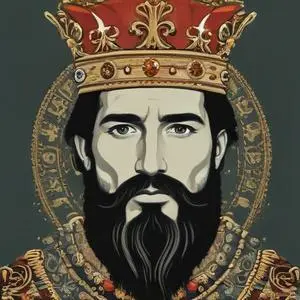
Edward II of England: The Controversial King
A Troubled Reign and a Legacy of Conflict
Edward II of England is infamous for his tumultuous reign, marked by power struggles, scandals, and military defeats. He is often regarded as one of the weakest kings in English history, known for his poor decision-making and favoritism towards his friends and courtiers.
Early Life and Accession
Born on April 25, 1284, Edward was the fourth son of Edward I and Eleanor of Castile. Following the death of his older brother Alphonso, Edward became the heir to the throne. In 1300, he accompanied his father on campaigns in Scotland, where he was knighted in a grand ceremony at Westminster Abbey. Edward succeeded to the throne in 1307, following his father's death.
Marrriage and Controversy
In 1308, Edward married Isabella of France, the daughter of King Philip IV, as part of a long-running effort to resolve the tensions between the English and French crowns. However, his close and controversial relationship with Piers Gaveston, who had joined his household in 1300, sparked widespread discontent among the barons and the French royal family.
The Rise and Fall of Piers Gaveston
The precise nature of Edward and Gaveston's relationship is uncertain – they may have been friends, lovers, or sworn brothers. Gaveston's arrogance and power as Edward's favorite provoked discontent among the barons, who pressured the King into agreeing to wideranging reforms called the Ordinances of 1311. The newly empowered barons banished Gaveston, to which Edward responded by revoking the reforms and recalling his favorite.
The Despenser Family and the Downfall of Edward II
The Despenser family, in particular Hugh Despenser the Younger, became close friends and advisers to Edward. However, in 1321, the Earl of Lancaster and many of the barons seized the Despensers' lands and forced the King to exile them. In response, Edward led a short military campaign, capturing and executing Lancaster. This move proved to be a fatal mistake, as it led to his eventual downfall and deposition in 1327.
Military Defeats and Famine
Edward's military campaigns were marked by failure, including a decisive defeat at the Battle of Bannockburn in 1314, where he was defeated by
Robert the Bruce. Widespread famine followed, and criticism of the King's reign mounted.
Legacy and Impact
Edward II's reign was marked by controversy, conflict, and poor decision-making. His legacy is one of a weak and ineffective king, who was deposed by his own nobles. Despite his flaws, Edward II played a significant role in shaping the course of English history, and his reign remains a fascinating and complex topic of study.
Interesting Facts and Trivia
- Edward II was the first English king to establish a permanent navy.
- He was known for his love of entertainment, and his court was famous for its lavish parties and tournaments.
- Edward II was deposed in January 1327, and died in September of the same year, allegedly murdered on the orders of his wife and her lover, Roger Mortimer.
Conclusion
Edward II of England's reign was a tumultuous and troubled period in English history. His poor decision-making, favoritism, and military defeats led to his eventual downfall and deposition. Despite his flaws, Edward II remains a fascinating figure, whose legacy continues to shape our understanding of medieval England.
FAQ
Who was Edward II of England and what was his reign like?
Edward II of England was King of England from 1307 to 1327, known for his conflicts with the nobility and his eventual deposition and murder.
What were Edward IIs relationships with the nobility?
Edward IIs reign was marked by conflicts with the nobility, including disputes over power, territory, and taxation, leading to several rebellions and eventual deposition.
What was the Despenser War?
The Despenser War was a conflict between Edward II and the nobility, sparked by the kings favoritism towards the Despenser family, leading to a civil war and eventual deposition.
What was Edward IIs impact on English politics?
Edward IIs reign had a significant impact on English politics, establishing the concept of parliamentary monarchy and promoting the power of the nobility.
How did Edward II die?
Edward II was allegedly murdered on September 21, 1327, in Berkeley Castle, Gloucestershire, reportedly by being suffocated or septicaemia.