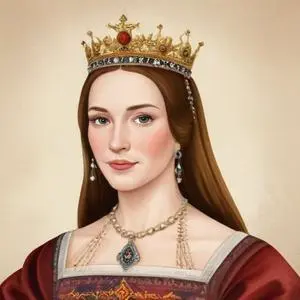
Margaret Tudor: The Queen Who Shaped the Fate of Scotland
Margaret Tudor, the eldest daughter of King
Henry VII of England and
Elizabeth of York, is best known for her role as Queen of Scotland from 1503 until 1513 by marriage to King James IV. This union not only solidified the Treaty of Perpetual Peace between England and Scotland but also paved the way for the House of Stuart to eventually accede to the throne of England.
The Early Years
Born on November 28, 1489, in the Palace of Westminster in London, Margaret was the second child and firstborn daughter of the royal couple. Despite being part of the English royal family, Margaret's life was marked by a strong connection to Scotland, which would become her adopted home.
A Royal Marriage and a New Era
At the tender age of 13, Margaret married
James IV of Scotland, cementing the Treaty of Perpetual Peace between the two nations. This union produced six children, although only one, James V, would survive to adulthood. Margaret's marriage to James IV marked the beginning of a new era in Scottish history, one that would eventually lead to the Union of the Crowns.
Regency and Power Struggles
Following James IV's untimely death at the Battle of Flodden in 1513, Margaret was appointed regent for her young son, James V. However, her position was soon threatened by a pro-French party that sought to replace her with John, Duke of Albany, the closest male relative to the infant king. In an effort to maintain her position, Margaret turned to the Douglases and married Archibald Douglas, 6th Earl of Angus, in 1514. This move, however, alienated other powerful nobles and ultimately led to her replacement as regent by Albany.
A Coup and Redemption
In 1524, Margaret, with the help of the Hamiltons, staged a successful coup, removing Albany from power while he was in France. This bold move earned her recognition as regent by Parliament, and later, as chief counsellor to King James V when he came of age.
Personal Relationships and Marriages
Margaret's personal life was marked by three marriages. Her first marriage to James IV produced six children, while her second marriage to Archibald Douglas, 6th Earl of Angus, in 1514, was followed by a divorce in 1527. Her third and final marriage was to Henry Stewart, 1st Lord Methven. Through her marriages, Margaret became the grandmother of both
Mary, Queen of Scots, and Mary's second husband, Lord Darnley.
Legacy and Impact
Margaret Tudor's legacy extends far beyond her personal relationships and marriages. Her role as Queen of Scotland and regent for her son paved the way for the House of Stuart to eventually accede to the throne of England. This union of the crowns, realized over a century later, remains a testament to Margaret's lasting impact on Scottish and English history.
FAQ
Who was Margaret Tudor and what was her role in Scottish history?
Margaret Tudor was the sister of Henry VIII of England and the wife of James IV of Scotland. She played a significant role in Scottish history, serving as queen consort and later as regent for her son, James V.
What was Margaret Tudors relationship with her husband, James IV?
Margaret Tudors marriage to James IV was a strategic alliance between England and Scotland, but it was also a loving relationship that produced several children.
How did Margaret Tudor influence Scottish politics?
Margaret Tudor exercised significant influence over Scottish politics, particularly during her regency for her son, James V. She worked to maintain peace with England and promote the interests of Scotland.
What was Margaret Tudors role in the Anglo-Scottish War?
Margaret Tudor played a key role in the Anglo-Scottish War, working to negotiate a peace treaty between England and Scotland and later leading Scottish forces against the English.
How is Margaret Tudor remembered in Scottish history?
Margaret Tudor is remembered as a strong and capable queen who worked to promote the interests of Scotland and maintain peace with England. Her legacy is that of a devoted wife, mother, and leader.