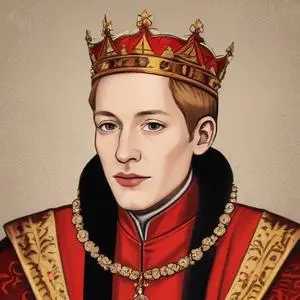
The Enigmatic Edward VI: A Brief yet Turbulent Reign
A King at Nine: The Rise to Power
Edward VI, the son of Henry VIII and his third wife,
Jane Seymour, is best known for being the first English monarch raised as a Protestant. At the tender age of nine, he ascended to the throne, becoming the King of England and Ireland from 1547 to 1553. This young monarch's reign would be marked by significant changes in the English Reformation, shaping the country's religious and political landscape.
A Protégé of Protestantism
Edward's early life was heavily influenced by his father's desire to secure the Tudor dynasty. Henry VIII's marital woes and the English Reformation paved the way for Edward's Protestant upbringing. His education, under the guidance of esteemed scholars like Richard Cox and
John Cheke, instilled in him a strong Protestant ethos. This foundation would later shape his reign, as he sought to establish the Church of England as a distinctly Protestant institution.
A Turbulent Reign: Power Struggles and Rebellions
Edward's reign was marked by power struggles between various councilors and factions vying for control. The Duke of Somerset, Edward Seymour, was instrumental in shaping the young king's policies, but his increasing unpopularity led to his eventual downfall. The Duke of Northumberland, John Dudley, subsequently seized power, only to face his own demise after Edward's death. These power struggles were accompanied by widespread unrest, including Kett's Rebellion in Norfolk and the Prayer Book Rebellion in the west country.
Religious Reforms and the Book of Common Prayer
Edward's reign saw significant religious reforms, which aimed to create a more Protestant Church of England. The Book of Common Prayer, introduced in 1549, was a key component of these reforms. This liturgical text standardized worship across the country, solidifying the English Reformation's Protestant character. While not without controversy, the Book of Common Prayer remains an important milestone in the development of Anglicanism.
A Life Cut Short: Edward's Decline and Legacy
Edward's health began to deteriorate in 1552, and he eventually succumbed to tuberculosis in 1553, at the age of 16. His reign, while brief, had a profound impact on English history. The seeds of Protestantism sown during his reign would continue to shape the country's religious identity, influencing the development of Anglicanism and beyond.
Comparative Analysis: A Tudor Enigma
In contrast to his more famous parents, Edward VI remains somewhat of an enigma. His reign, though marked by turmoil, was characterized by a distinct Protestant character. This sets him apart from his predecessors, who navigated the complexities of Catholicism and Henrician reform. While his reign was fleeting, its impact on the English Reformation remains significant.
Personal Milestones and Key Life Events
- 1537: Edward VI is born on October 12th at Hampton Court Palace
- 1547: Edward ascends to the throne at the age of nine
- 1549: The Book of Common Prayer is introduced, solidifying the English Reformation's Protestant character
- 1552: Edward's health begins to decline
- 1553: Edward VI dies on July 6th at Greenwich Palace
Impact on Modern Society
Edward VI's reign continues to influence modern society, particularly in the realm of Anglicanism. The Book of Common Prayer, a product of his reforms, remains an important liturgical text in the Church of England. Furthermore, the English Reformation, shaped by Edward's Protestant upbringing, has had far-reaching impacts on Western Christianity.
Trivia and Fun Facts
- Edward VI was the first English monarch to be raised as a Protestant
- He was known for his intelligence and linguistic prowess, speaking Latin, Greek, and French
- Edward's love for music and the arts was evident in his patronage of the composer, Thomas Tallis
FAQ
Who was Edward VI and what was his role in English history?
Edward VI was King of England and Ireland from 1547 to 1553, succeeding his father Henry VIII. He played a significant role in the English Reformation and the development of the Church of England.
What were the key policies of Edward VIs reign?
Edward VIs reign saw the implementation of Protestant reforms, including the introduction of the Book of Common Prayer and the suppression of Catholic practices. He also promoted education and trade.
How did Edward VIs reign impact the English monarchy?
Edward VIs reign marked a significant shift in the balance of power between the monarchy and Parliament, paving the way for future monarchs to rule with greater consultation and cooperation.
What was Edward VIs relationship like with his advisors?
Edward VI was heavily influenced by his powerful advisors, including John Dudley, 1st Duke of Northumberland, and Edward Seymour, 1st Duke of Somerset, who shaped his policies and decisions.
What led to Edward VIs untimely death?
Edward VI died of tuberculosis in 1553, at the age of 15, after a long illness. His death led to a succession crisis, with Mary I (Mary Tudor) eventually inheriting the throne.