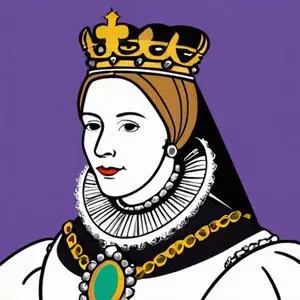
Mary I of England: The Controversial Queen of England and Ireland
A Legacy of Blood and Fire
Mary I of England, also infamous as Bloody Mary, is notorious for her relentless pursuit to restore Catholicism in England and Ireland during her reign from 1553 to 1558. She is remembered for her brutal persecution of Protestants, earning her a place in history as one of the most divisive and feared monarchs of England.
Early Life and Succession
Born on February 18, 1516, at the Palace of Placentia in Greenwich, England, Mary was the only surviving child of King Henry VIII and his first wife,
Catherine of Aragon. Declared illegitimate and barred from the line of succession following her parents' marriage annulment in 1533, Mary's fate was later reversed via the Third Succession Act of 1543.
Rise to Power
After the death of her younger half-brother,
Edward VI, in 1553, Mary speedily assembled a force in East Anglia and deposed Lady Jane Grey, who had been proclaimed queen by Edward's Protestant supporters. Mary was subsequently crowned queen, becoming the first queen regnant of England.
The Marian Persecutions
During her five-year reign, Mary had over 280 religious dissenters burned at the stake in a bid to restore Catholicism in England. This period, known as the Marian persecutions, earned her the reputation as Bloody Mary. Her actions were met with fierce resistance from Protestants, who saw her as a tyrannical ruler.
Marriage and Foreign Policy
In July 1554, Mary married Prince Philip of Spain, becoming queen consort of Habsburg Spain on his accession in 1556. This marriage was a strategic move to strengthen England's ties with Spain and secure support for her Catholic reforms.
Legacy and Impact
Mary's reign was marked by controversy and bloodshed, but she also played a significant role in shaping England's history. Her attempts to restore Catholicism laid the groundwork for the Catholic Revival of the 19th century. Her marriage to Philip of Spain also introduced Spanish culture to England, influencing art, literature, and architecture.
Influence on Modern Society
Mary's legacy extends beyond her reign. She is often seen as a symbol of female empowerment, being one of the first women to wield significant power in England. Her story has also inspired numerous literary and artistic works, including plays, novels, and films.
Philosophical Contributions and Beliefs
Mary's strong Catholic convictions and her determination to restore Catholicism in England reflect her deep commitment to her faith. Her beliefs were shaped by her upbringing and her parents' influence, particularly her mother, Catherine of Aragon, who was a devout Catholic.
Personal Milestones and Key Life Events
- 1516: Born on February 18th at the Palace of Placentia in Greenwich, England
- 1533: Declared illegitimate and barred from the line of succession
- 1543: Restored to the line of succession via the Third Succession Act
- 1553: Became Queen of England and Ireland after the death of Edward VI
- 1554: Married Prince Philip of Spain
- 1556: Became Queen Consort of Habsburg Spain
- 1558: Died on November 17th, ending her reign
Trivia and Fun Facts
- Mary was known for her love of fine clothes and jewelry, often wearing elaborate dresses and adornments.
- She was a talented musician and enjoyed playing the lute and the virginals.
- Mary's nickname "Bloody Mary" was first used by her Protestant opponents to describe her brutal persecution of Protestants.
FAQ
Who was Mary I of England and what was her reign like?
Mary I of England, also known as Mary Tudor, was the Queen of England and Ireland from 1553 to 1558. Her reign was marked by a series of brutal persecutions of Protestants, earning her the nickname Bloody Mary.
What was Mary Is relationship like with her sister Elizabeth?
Mary I and her sister Elizabeth had a tumultuous relationship, with Mary imprisoning Elizabeth in the Tower of London on suspicion of plotting against her. Elizabeth later succeeded Mary as Queen of England.
What were Mary Is goals for England during her reign?
Mary Is primary goal was to restore Catholicism in England, which had been largely abolished by her predecessor and brother, Edward VI. She also sought to marry Prince Philip of Spain to secure an alliance with Spain.
How did Mary I die?
Mary I died of a lung disease, likely pulmonary embolism or pneumonia, on November 17, 1558. She was succeeded by her sister Elizabeth, who became one of the most beloved monarchs in English history.
What is Mary Is legacy in English history?
Mary Is legacy is largely defined by her brutal persecution of Protestants, which earned her a reputation as a tyrant. However, she also played a key role in shaping the English Reformation and setting the stage for the Elizabethan era, which saw a flowering of English culture and literature.