


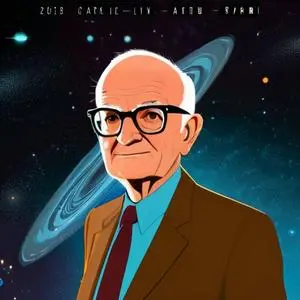
Pioneering science fiction author who wrote prophetic and imaginative novels, such as "2001: A Space Odyssey", that explored the intersection of technology and humanity.
Sir Arthur C. Clarke was a British science fiction writer, futurist, and inventor, best known for his iconic novel and screenplay for the 1968 film 2001: A Space Odyssey, widely regarded as one of the most influential films of all time. He was a pioneer in popularizing space travel and predicting the future of technology, earning him the moniker "Prophet of the Space Age."
Born on December 16, 1917, in Minehead, Somerset, England, Clarke grew up in nearby Bishops Lydeard. He developed an interest in science fiction at an early age and began writing his own stories while still a teenager.
In the 1940s and 1950s, Clarke's science fiction writing career took off, earning him numerous Hugo and Nebula awards. He wrote many novels and essays for popular magazines, including Childhood's End, Rendezvous with Rama, and The City and the Stars. His work was widely acclaimed, and he became one of the "Big Three" of science fiction, alongside Robert Heinlein and Isaac Asimov.
Clarke's fascination with space travel and technology led him to propose a satellite communication system using geostationary orbits in 1945. He was a lifelong advocate for space exploration and was appointed as the chairman of the British Interplanetary Society in 1946.
In 1956, Clarke emigrated to Ceylon (now Sri Lanka) to pursue his interest in scuba diving. While there, he discovered the underwater ruins of the ancient original Koneswaram Temple in Trincomalee. He lived in Sri Lanka until his death, hosting television shows such as Arthur C. Clarke's Mysterious World in the 1980s.
Sir Arthur C. Clarke's contributions to science fiction, futurism, and space exploration have had a lasting impact on modern society. His predictions and writings have inspired generations of scientists, engineers, and writers. He will always be remembered as a true visionary and pioneer in his field.
"The only way of discovering the limits of the possible is to go beyond them into the impossible."
"When I eventually met Stanley Kubrick, I realized that he was the only person I knew who was more obstinate than I was. We were a perfect match."
Clarke's legacy continues to inspire and fascinate people around the world, and his work remains a testament to his boundless imagination and innovative spirit.
Born in 1920
A renowned science fiction author and biochemistry professor who wrote or edited more than 500 books and an estimated 90,000 letters and postcards throughout his lifetime.
Born in 1920
Prolific author of poetic and imaginative science fiction, exploring the human condition through fantastical worlds and characters, with works adapted into films and TV shows.
98 Years Old
Visionary filmmaker behind iconic, visually stunning, and thought-provoking movies that often explored the human condition, pushing boundaries of storytelling and cinematography.
82 Years Old
Creator of the iconic Star Wars franchise, revolutionizing the sci-fi genre with groundbreaking storytelling and visual effects. Founded Lucasfilm, a pioneering production company.
79 Years Old
Acclaimed filmmaker behind iconic movies like Jaws, E.T., and Jurassic Park, revolutionizing the film industry with his imaginative storytelling and visual effects. Co-founder of DreamWorks, a prominent production company.
91 Years Old
A renowned space expert who explored the universe, searching for life beyond Earth and explaining complex science in simple terms.
96 Years Old
First person to walk on the Moon during the Apollo 11 mission, marking a historic milestone in space exploration.
96 Years Old
Second man to walk on the Moon during the Apollo 11 mission, a pioneering astronaut and advocate for space exploration.
