


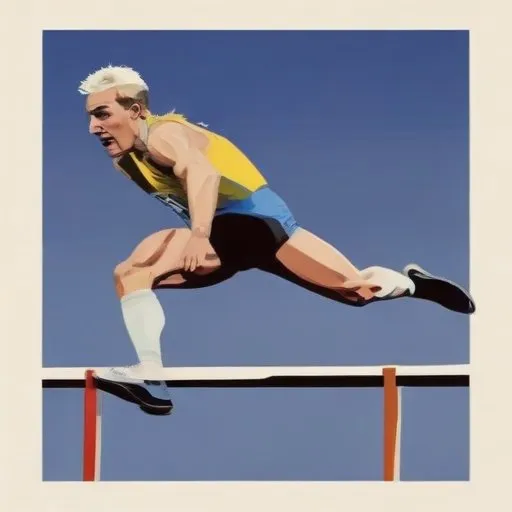
A Finnish athlete who won Olympic and European Championship medals in the 110m hurdles, later becoming a politician and serving in the Finnish Parliament. He's a notable figure in Finnish sports and politics.
Arto Kalervo Bryggare is renowned as one of Finland's most accomplished athletes, celebrated for his exceptional hurdling skills that earned him numerous accolades and broke records in the sport. Born on May 26, 1958, in Kouvola, Finland, Bryggare is best known for being the first Finn to medal in a sprint event shorter than 400 meters.
Bryggare's remarkable talent was evident from a young age. At just 18, he claimed the bronze medal in the 60m hurdles at the 1977 European Indoor Championships, followed by the European Junior Championship title in the 110m hurdles. By 1978, he had already solidified his position among the world's top ten high hurdlers, earning a bronze medal at the European Championships in Prague with a time of 13.56 seconds.
In 1979, Bryggare continued to impress, finishing second at the European Indoors behind the dominant East German hurdler, Thomas Munkelt. His notable performance at the 1980 Olympic Games in Moscow, where he advanced to the final of the 110m hurdles, further cemented his reputation as a force to be reckoned with in the sport.
Bryggare's crowning achievements include his world silver medal in 1983 and Olympic bronze medal in 1984, both in the 110m hurdles. His personal best time of 13.35 seconds, achieved during the 1984 Los Angeles Games, remains the Finnish and Nordic record to this day.
Beyond his athletic accomplishments, Bryggare also ventured into politics, serving as a member of the Finnish Parliament from 1995 to 1999 and again from 2003 to 2007, representing the Social Democratic Party of Finland.
Arto Bryggare's remarkable hurdling career has left an indelible mark on Finnish athletics and the global track and field community. His legacy continues to inspire future generations of Finnish athletes, solidifying his place as one of the country's most celebrated sports icons.
Did you know that Arto Bryggare's personal best time of 13.35 seconds remains the Finnish and Nordic record in the 110m hurdles?
This article has explored the remarkable life and achievements of Arto Bryggare, a true Finnish sporting icon. His enduring legacy continues to inspire and motivate athletes and individuals around the world.
77 Years Old
A Finnish runner and police officer who won four Olympic gold medals in the 1970s, setting multiple world records in the 5,000 and 10,000 meters. He's a national hero in Finland for his athletic achievements.
78 Years Old
A Finnish middle- and long-distance runner who won gold in the 1972 Munich Olympics, setting a new world record in the 1500 meters. He's a celebrated athlete in Finland's sports history.
72 Years Old
A Finnish middle- and long-distance runner who won silver and bronze medals at the 1980 Summer Olympics, setting multiple national records in the process.
89 Years Old
Finnish cross-country skier who won seven Olympic medals, including three golds, and was known for his exceptional endurance and speed. He was a dominant force in the sport during the 1960s.
