


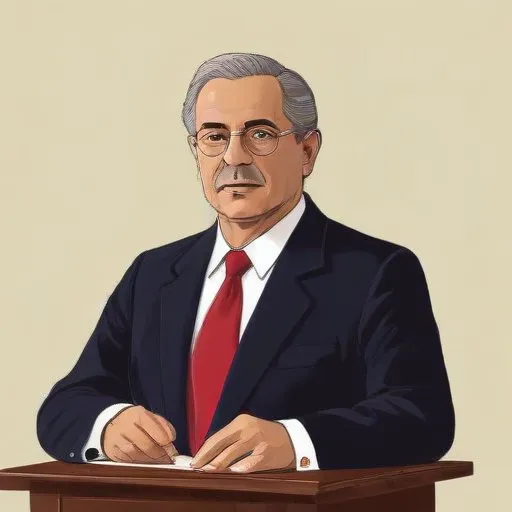
A Venezuelan lawyer, journalist, and author who wrote influential novels and essays that explored the country's history, politics, and culture, earning him a Nobel Prize nomination. He's a national literary icon in Venezuela.
Known for his profound impact on Venezuelan politics, literature, and education, Arturo Uslar Pietri was a multifaceted personality who left an indelible mark on his country's history. As a writer, historian, television producer, and politician, he championed the values of mestizaje, or miscegenation, and played a crucial role in shaping Venezuela's democratic era.
Born on May 16, 1906, in Caracas, Venezuela, to General Arturo Uslar Santamara and Helena Pietri de Uslar, Arturo's early life was marked by frequent moves to various cities in the country's central northern valleys. He returned to Caracas in 1924 to pursue a degree in political sciences at the Central University of Venezuela, graduating as a Doctor of Political Sciences in 1929. He also obtained a law degree the same year.
Uslar's remarkable career spanned multiple fields, with significant contributions to Venezuelan politics, historical analysis, literature, and education. He held esteemed positions such as Secretary for the Venezuelan Delegation at the League of Nations, delegate at the International Labour Organization, Minister of Education, Minister of Finance, and Ambassador to the United States.
Uslar Pietri's literary output was immense, with influential essays and novels that showcased his championing of mestizaje. His most famous work, The Red Lances, offers a poignant account of life during the Venezuelan War of Independence from various social perspectives. This novel has been hailed as a masterpiece of Venezuelan literature, highlighting the author's ability to weave together historical facts with captivating storytelling.
Uslar Pietri's philosophy centered around the importance of embracing Venezuela's mixed cultural heritage. He believed that the fusion of European, African, and indigenous roots was a valuable asset, and that this unique blend of cultures was essential to the country's identity. Through his writing and public service, he promoted the values of tolerance, understanding, and cultural exchange.
Arturo Uslar Pietri's impact on modern Venezuelan society is undeniable. His commitment to democracy, education, and cultural preservation has inspired generations of Venezuelans. As a television producer, he promoted cultural programming that highlighted the country's rich heritage, further solidifying his position as a cultural icon.
Uslar Pietri's remarkable life came full circle on February 26, 2001, when he passed away, leaving behind a legacy that continues to inspire and educate Venezuelans. His contributions to literature, politics, and education have cemented his place as one of the most influential figures in Venezuelan history.
As we reflect on Arturo Uslar Pietri's extraordinary life, we are reminded of the power of vision, dedication, and passion. His unwavering commitment to his country and his people has left an indelible mark on Venezuela, and his literary works continue to captivate readers around the world.
Born in 1884
A pioneering Venezuelan writer and statesman who served as president, known for his influential novels that explored the country's cultural identity and his brief but significant presidency.
Born in 1781
A leading figure in Latin American literature and philosophy, known for his influential poetry and essays that shaped the region's cultural identity. He's also credited with creating the modern Spanish language grammar rules.
Born in 1857
A Venezuelan strongman who ruled with an iron fist, modernizing the country while suppressing dissent, and amassing a vast fortune through oil concessions. He's remembered for his authoritarian regime and economic development.
75 Years Old
A bishop-turned-president who fought for social justice and land reform in Paraguay, leading to significant political and economic changes. He's known for his commitment to helping the poor and marginalized.
