


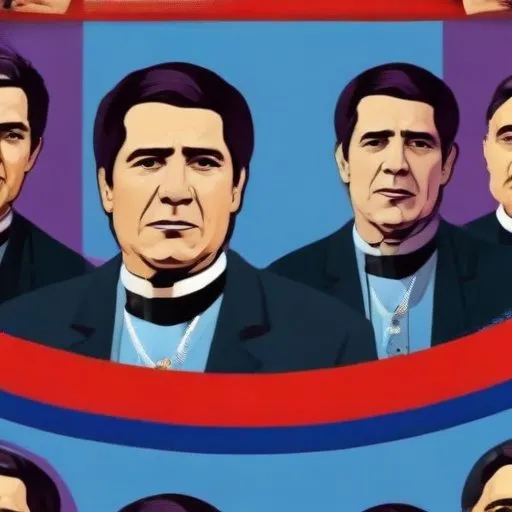
A bishop-turned-president who fought for social justice and land reform in Paraguay, leading to significant political and economic changes. He's known for his commitment to helping the poor and marginalized.
Fernando Lugo is a Paraguayan politician and laicized Catholic bishop who made history by becoming the President of Paraguay from 2008 to 2012, ending 61 years of rule by the Colorado Party. He is known for his unique blend of spiritual and political leadership, having served as the Bishop of the Diocese of San Pedro from 1994 to 2005 before venturing into politics.
Born on May 30, 1951, Lugo received his basic education at a religious school in Encarnacin. Despite his family not being particularly religious, they were active in Colorado Party politics. His maternal uncle, Epifanio Mndez Fleitas, was a coconspirator in the 1954 Paraguayan coup dtat that helped bring Alfredo Stroessner to power.
Lugo's father wanted him to become a lawyer, but he entered a normal school at 18 and began teaching in a rural community. This experience led him to discover his vocation to the Roman Catholic priesthood. He entered a seminary operated by the Society of the Divine Word at 19 and was ordained a priest for the society on August 15, 1977.
Lugo was sent to Ecuador as a missionary for five years, where he learned about liberation theology and taught classes at the Catholic University of Ecuador. He returned to Paraguay in 1982 and became the Bishop of the Diocese of San Pedro in 1994.
As a bishop, Lugo was critical of the dictatorial regime of Alfredo Stroessner and advocated for social justice and human rights. He resigned as bishop in 2005 to pursue a career in politics, citing the need for a "more direct involvement in the country's political life."
In 2008, Lugo was elected as the President of Paraguay, ending 61 years of rule by the Colorado Party. His presidency was marked by efforts to reduce poverty, improve education, and promote land reform.
However, Lugo's presidency was cut short when he was removed from office through an impeachment process in 2012. Neighboring countries deemed the process a coup dtat, and Lugo claimed that he was the victim of a parliamentary coup.
After his impeachment, Lugo was elected to the Senate of Paraguay in 2013 and 2018. Although he failed to win reelection in the 2023 Paraguayan general election, he remains a prominent figure in Paraguayan politics.
Lugo's legacy is complex and multifaceted. While he was criticized for his handling of the economy and his relationship with the legislature, he is also praised for his commitment to social justice and his efforts to reduce poverty.
Lugo's approach to politics was deeply influenced by liberation theology, which emphasizes the need for the Church to advocate for the poor and marginalized. He believed that politics should be guided by moral principles and a commitment to social justice.
Lugo's life is a testament to the power of perseverance and commitment to social justice. Despite facing numerous challenges and setbacks, he remained dedicated to his principles and continued to fight for the rights of the poor and marginalized.
As a politician and bishop, Lugo's life serves as an inspiration to those who believe in the importance of combining faith and politics to create a more just and equitable society.
70 Years Old
A wealthy entrepreneur who turned to politics, serving as President of Paraguay from 2013 to 2018, known for his business acumen and efforts to modernize the country's economy.
