


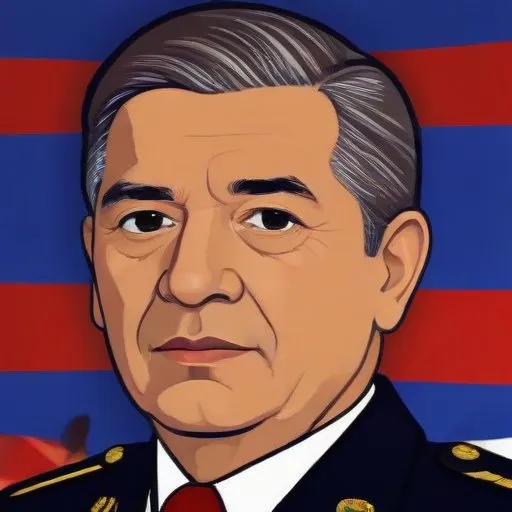
A ruthless dictator who ruled Paraguay for 35 years, suppressing opposition and human rights, while maintaining a tight grip on power through corruption and violence.
Alfredo Stroessner is notoriously known for his 35-year iron-fisted rule as the President of Paraguay, a period marked by brutal repression, human rights abuses, and corruption. His regime, often referred to as "El Stronato," remains one of the darkest chapters in Paraguayan history.
Born on November 3, 1912, in Encarnación, Paraguay, Alfredo Stroessner Matiauda was the son of Hugo Strössner, a German immigrant. Stroessner's early life was marked by military education and training, which ultimately led him to become a prominent figure in the Paraguayan army.
In 1954, Stroessner led a successful coup d'état, backed by the army and the Colorado Party. Following a brief provisional government, he became the party's presidential candidate in the 1954 general election, running unopposed due to the ban on other parties from 1947 to 1962. On August 15, 1954, Stroessner officially assumed the presidency, marking the beginning of his authoritarian regime.
Stroessner's rule was characterized by harsh repression, torture, and human rights abuses. He suspended constitutional and civil rights, using the army and military police as a secret police to crush opposition. Despite legalizing opposition parties in 1962, Stroessner continued to suppress dissent, and his regime became notorious for its brutality.
In 1967, Stroessner introduced a new constitution, which enabled him to reelect himself in 1977. He subsequently modified the constitution to permit himself to be reelected indefinitely, fraudulently winning seven consecutive elections from 1958 to 1988.
In 1989, Stroessner's most trusted confidant, Lieutenant General Andrés Rodríguez Pedotti, led a coup d'état, overthrowing Stroessner from power. Two days later, he was exiled to Brazil, where he spent the remainder of his life.
Stroessner died on August 16, 2006, at the Santa Luzia Hospital in Brasília, Brazil, due to complications from pneumonia. He was buried in the Campo da Esperança Cemetery. Stroessner's legacy is marked by controversy, human rights abuses, and corruption, earning him a place as one of the most reviled dictators in South American history.
Stroessner's regime had a profound impact on modern Paraguayan society, leaving a legacy of fear, mistrust, and political instability. His authoritarian rule also had far-reaching consequences for human rights, democracy, and the rule of law in the region.
Stroessner's regime is often compared to those of other Latin American dictators, such as Augusto Pinochet in Chile and Jorge Videla in Argentina. While sharing similarities with these regimes, Stroessner's rule is distinct in its brutality and longevity.
Born in 1794
A charismatic and cunning leader who dominated Mexican politics for decades, known for his role in the Texas Revolution and multiple presidential terms.
Born in 1895
The authoritarian leader who ruled Argentina with his charismatic wife Eva, implementing populist economic policies and promoting nationalism, while suppressing opposition and civil liberties.
Born in 1882
A dominant leader who ruled Brazil from 1930 to 1945 and again from 1951 until his suicide in 1954, known for implementing reforms and promoting nationalism.
72 Years Old
The charismatic leader who transformed Venezuela through socialist reforms and anti-imperialist rhetoric, leaving a lasting impact on the country's politics and economy.
Born in 1926
The Cuban revolutionary who led the country from 1959 to 2008, implementing socialist policies and defying US opposition, becoming an iconic figure in modern history.
Born in 1891
A ruthless dictator who ruled the Dominican Republic with an iron fist, known for his brutal suppression of opposition and human rights abuses.
Born in 1908
Led Venezuela's transition from dictatorship to democracy, serving as president from 1945 to 1948 and again from 1959 to 1964, implementing social and economic reforms.
