


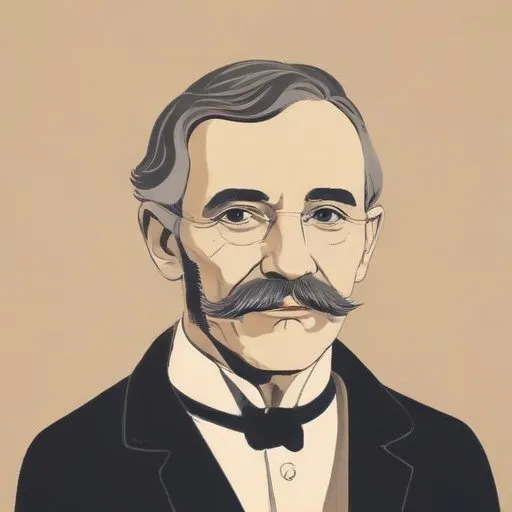
A renowned botanist and mycologist who made significant contributions to the field of plant classification and discovery, particularly in the areas of plant geography and phytogeography.
Augustin Pyramus de Candolle is renowned for his groundbreaking contributions to the field of botany, particularly in the areas of plant classification, phytogeography, and natural selection. His profound understanding of plant biology and ecosystems has had a lasting impact on the scientific community, influencing prominent figures such as Charles Darwin.
Born on February 4, 1778, in Geneva, Republic of Geneva, Augustin Pyramus de Candolle came from a family of French descent that had relocated to Geneva in the 16th century to escape religious persecution. Despite contracting a severe case of hydrocephalus at the age of seven, which significantly affected his childhood, de Candolle demonstrated exceptional aptitude for learning.
René Louiche Desfontaines, a prominent botanist, launched de Candolle's botanical career by recommending him at a herbarium. Within a few years, de Candolle established a new genus, and his work continued to flourish, documenting hundreds of plant families and creating a new natural plant classification system.
De Candolle's work expanded beyond botany, influencing related fields such as:
De Candolle originated the idea of "Nature's War," which suggests that multiple species may develop similar characteristics that did not appear in a common evolutionary ancestor. This concept, now known as convergent evolution, significantly influenced Charles Darwin's theory of natural selection.
During his research on plant leaf movements, de Candolle observed that plants follow a near 24-hour cycle in constant light, suggesting the existence of an internal biological clock. Although many scientists doubted his findings, experiments over a century later confirmed the presence of this internal clock.
De Candolle's descendants continued his work on plant classification, with his son Alphonse and grandson Casimir contributing to the Prodromus Systematis Naturalis Regni Vegetabilis, a comprehensive catalog of plants begun by Augustin Pyramus de Candolle.
De Candolle was honored with numerous awards and recognition for his contributions to botany, including election as a foreign member of the Royal Swedish Academy of Sciences in 1810.
De Candolle's passion for nature and science is reflected in his quote: "The universe is not a collection of distinct objects, but a continuum of interconnected things."
Augustin Pyramus de Candolle's groundbreaking work has left an indelible mark on the scientific community, inspiring future generations of botanists and naturalists to continue exploring the wonders of the natural world.
Born in 1809
Developed the theory of evolution through natural selection, revolutionizing our understanding of life on Earth. This groundbreaking idea transformed the fields of biology, ecology, and beyond.
Born in 1744
A French soldier, biologist, and academic who developed a theory of inheritance of acquired characteristics, proposing that organisms adapt to their environment and pass on those traits to their offspring.
Born in 1817
A renowned botanist and explorer who contributed significantly to the discovery and classification of numerous plant species, particularly in the Himalayas and Antarctica. His work laid the foundation for modern botanical research.
Born in 1810
A pioneering botanist who contributed significantly to the development of American botany, particularly in the fields of plant classification and evolution.
Born in 1727
A French naturalist who made significant contributions to the fields of botany, entomology, and mycology, particularly in the discovery and classification of new species. His work laid the foundation for modern taxonomy.
