


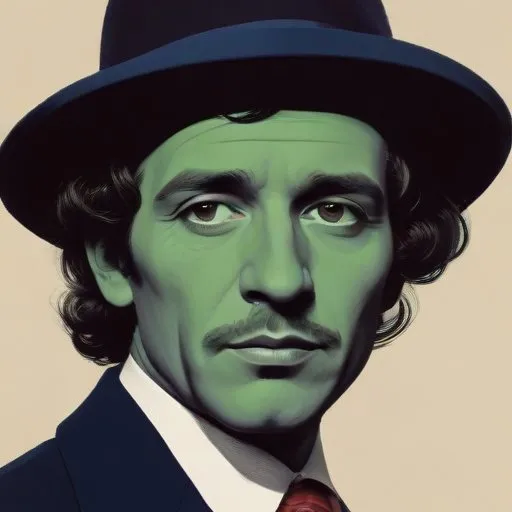
A prominent figure in British art, known for vibrant portraits and landscapes that captured the essence of his subjects, often blending realism with romanticism.
Augustus John is renowned for his breathtaking paintings, draughtsmanship, and etchings that captivated the British art scene in the early 20th century. He was hailed as the most important artist of his time, earning praise from literary giants like Virginia Woolf, who declared that "the era of John Singer Sargent and Charles Wellington Furse... was over. The age of Augustus John was dawning."
Born on January 4, 1878, in Tenby, Pembrokeshire, Wales, John was the younger son and third of four children to Edwin William John, a Welsh solicitor, and Augusta Smith, a descendant of Sussex master plumbers. Tragedy struck when his mother passed away when he was just six years old, but not before instilling in him and his older sister Gwen a love for drawing.
At 17, John attended the Tenby School of Art before moving to London to study at the Slade School of Art, University College London. Under the guidance of drawing teacher Henry Tonks, John flourished, becoming the star pupil and the most talented draughtsman of his generation. His sister Gwen was also a student at the Slade and would go on to become an accomplished artist in her own right.
In 1897, a serious head injury from diving into the sea at Tenby led to a lengthy convalescence, which unexpectedly stimulated John's adventurous spirit and artistic growth. The following year, he won the Slade Prize with his work "Moses and the Brazen Serpent." This triumph marked the beginning of his journey to artistic stardom.
John's subsequent studies in Paris, where he was influenced by Pierre Puvis de Chavannes, further refined his craft. In 1901, he married Ida Nettleship and began teaching art at the University of Liverpool to support his growing family. During this period, he also explored the Welsh countryside, capturing its beauty on canvas.
Augustus John's work is characterized by its expressive, bold, and vibrant quality, often featuring landscapes, portraits, and still-life compositions. His artistic style, although influenced by Impressionism and Post-Impressionism, remained distinct and innovative, earning him widespread acclaim.
Today, John's paintings are highly regarded for their historical significance, capturing the essence of British life and culture during the early 20th century. His artworks can be found in prominent museums and galleries, including the National Museum of Wales, the Tate Britain, and the National Portrait Gallery in London.
John's personal life was marked by tumultuous relationships and scandals. His marriage to Ida Nettleship ended in tragedy when she passed away in 1907. He later married Dorothy McNeill, with whom he had several children. John's close friendship with James Dickson Innes, a fellow artist, was also significant, and the two friends often painted together in the Arenig valley in North Wales.
In spite of controversies and personal struggles, Augustus John's artistic genius and unwavering passion for his craft have endured, cementing his position as one of the most celebrated Welsh painters of all time.
Born in 1882
A pioneering figure in the Vorticist movement, creating avant-garde paintings and writings that critiqued modern society, blending art and literature.
Born in 1880
A pioneering modernist sculptor, known for his bold, expressive, and often controversial works that pushed the boundaries of traditional representation, exploring the human form with intense emotional power.
Born in 1869
A pioneering artist who revolutionized modern art with bold, expressive, and colorful works that blurred the lines between painting and sculpture, creating a new language of form and color.
Born in 1881
A pioneering artist who transformed modern art with pioneering Cubist works, creating a new visual language that continues to inspire and influence art, design, and culture.
Born in 1884
An Italian artist famous for elongated, emotive portraits and nudes that blended primitivism with cubism, capturing the essence of his subjects with expressive simplicity.
Born in 1885
A pioneering modernist poet and critic who transformed 20th-century literature with innovative styles and provocative ideas, shaping the course of modern poetry.
Born in 1888
A renowned poet, playwright, and critic who reshaped modern poetry with works like "The Waste Land" and "Old Possum's Book of Practical Cats", influencing literature and art with their unique style.
Born in 1914
A renowned wordsmith celebrated for his emotive, lyrical poetry and plays that explored the human condition, particularly in his iconic work "Under Milk Wood".
