


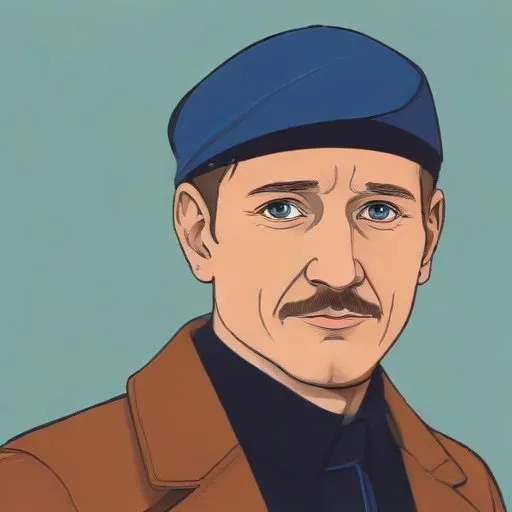
Estonian-Scottish sculptor and engineer created intricate, figurative bronze works, often depicting Scottish and Estonian folklore, and held a prestigious position at the Glasgow School of Art.
Benno Schotz, one of Scotland's leading artists of the 20th century, left an indelible mark on the world of sculpture with his expressive and emotive works. As a prolific artist, he produced hundreds of portraits and compositions that continue to inspire and intrigue art lovers to this day.
Schotz was born on August 28, 1891, in Estonia to Jewish parents, Jacob Schotz, a watchmaker, and Cherna Tischa Abramovitch. He was the youngest of six children and received his education at the Boys Grammar School of Prnu, Estonia. Schotz's artistic inclination was evident from a young age, and he later pursued his passion by studying at the Grossherzogliche Technische Hochschule in Darmstadt, Germany.
In 1912, Schotz immigrated to Glasgow, Scotland, where he gained an engineering diploma from the Royal Technical College. This move marked the beginning of his connection with Glasgow, which would become a significant part of his life and artistic career. During his early years in Glasgow, Schotz worked in the drawing office of John Brown & Company, Clydebank shipbuilders, while attending evening classes in sculpture at the Glasgow School of Art.
Schotz's big break came in 1923 when he became a full-time sculptor. His talent and dedication caught the attention of William Boyd, a prominent art collector, who became an early patron and supporter of Schotz's work. As a result, Dundee Dental School and Dundee Art Galleries & Museums acquired several pieces by Schotz, cementing his reputation as a rising star in the art world.
Schotz's impressive career was marked by numerous accolades and honors. He became a full member of the Royal Scottish Academy and was appointed head of sculpture at the Glasgow School of Art, a position he held from 1938 to 1961. In 1963, he was appointed Sculptor in Ordinary for Scotland, a testament to his contribution to the world of sculpture.
Schotz's influence extended beyond his own work to inspire a new generation of artists. His pupils included notable artists such as Hannah Frank, Stewart Bowman Johnson, and Inge King (née Neufeld). His homes in West Campbell Street and later Kirklee Road became hubs for artistic and intellectual gatherings, attracting prominent figures from the worlds of art, literature, and politics.
Schotz was a committed Zionist and proud of his adopted Scotland. He continued to work until a few weeks before his death at the age of 93. He was buried in Jerusalem, a testament to his deep connection with his Jewish heritage.
Benno Schotz's remarkable life and career serve as a testament to his dedication, passion, and contribution to the world of sculpture. As one of Scotland's leading artists of the 20th century, his legacy continues to inspire and delight art lovers around the world.
Born in 1898
A pioneering Estonian printmaker and artist, renowned for his bold, expressive, and often unsettling etchings and engravings that explored the human condition.
Born in 1905
Estonian linguist and academic who studied and documented Finno-Ugric languages, making significant contributions to the field of linguistics, particularly in the study of Estonian and other Finno-Ugric languages.
Born in 1909
A renowned Estonian thinker who merged philosophy and theology to explore the human condition, producing influential works on existentialism and phenomenology.
85 Years Old
Estonian poet, philosopher, and critic known for blending Eastern and Western thought in his work, exploring themes of nature, culture, and human existence. His writing often weaves together poetry, essay, and philosophy.
