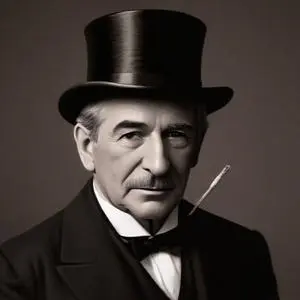
Bernard Baruch: The Financial Wizard Who Shaped America's Economic Destiny
A Master of the Markets
Bernard Baruch, a name synonymous with financial wizardry, is renowned for his extraordinary ability to predict and navigate the complexities of the American economy. This brilliant financier and statesman amassed a staggering fortune on the New York Stock Exchange, impressing President
Woodrow Wilson with his exceptional economic mobilization skills during World War I.
Early Life and Education
Born on August 19, 1870, in Camden, South Carolina, Bernard Baruch was the second of four sons to a Jewish family. His father, Simon Baruch, was a physician, Confederate soldier, and a member of the Ku Klux Klan. In 1879, the family moved to New York City, where Bernard attended local schools and later studied at the City College of New York.
Business Career: A Rise to Prominence
Baruch's journey to success began as a broker, eventually becoming a partner in A.A. Housman Company. With his earnings and commissions, he bought a seat on the New York Stock Exchange for $19,000 (equivalent to $700,000 in 2023). This strategic move marked the beginning of his ascent to financial stardom, as he amassed a fortune before the age of 30 by speculating on the sugar market, which was booming in Hawaii.
Philosophical Contributions and Beliefs
Baruch's investment philosophy was built on the principles of prudence, patience, and adaptability. He believed in the importance of diversification, stating, "Don't put all your eggs in one basket." His approach to investing was rooted in a deep understanding of the market's cyclical nature, allowing him to predict and prepare for downturns.
World War I and the War Industries Board
During World War I, Baruch's exceptional economic mobilization skills caught the attention of President Woodrow Wilson, who appointed him as the chairman of the War Industries Board. Baruch's leadership played a crucial role in managing the nation's economic resources, earning him the respect and admiration of Wilson.
The Post-War Boom and Crash Prediction
In the aftermath of World War I, Baruch made another fortune in the post-war bull market. However, he foresaw the Wall Street crash of 1929 and sold out his holdings well in advance, avoiding substantial losses. This remarkable foresight cemented his reputation as a financial genius.
World War II and the Role of Industry
During World War II, Baruch became a close advisor to President
Franklin D. Roosevelt, playing a crucial role in optimizing the production of tanks and aircraft. His efforts greatly shortened the production time, significantly contributing to the Allied forces' success.
Public Service and Legacy
In 1946, Baruch served as the United States representative to the United Nations Atomic Energy Commission, where he proposed the Baruch Plan for international control of atomic energy. Although the plan was rejected by the Soviet Union, it remains a testament to his commitment to global cooperation and peace.
Inspirational Quotes
- "Age is only a number. It's totally irrelevant unless, of course, you're a cheese."
- "During my eighty-seven years I have witnessed a whole succession of technological revolutions. But none of them has done away with the need for character in the individual or the ability to think."
Historical Context and Legacy
Bernard Baruch's remarkable life and achievements have left an indelible mark on American economic history. His incredible financial acumen, coupled with his dedication to public service, has inspired generations of investors, economists, and statesmen. As a testament to his enduring legacy, Baruch's name remains synonymous with financial wisdom and foresight.
FAQ
What was Bernard Baruchs role in World War I?
Bernard Baruch served as the chairman of the War Industries Board during World War I, playing a crucial role in mobilizing American industries to support the war effort. His leadership helped to increase production and efficiency, contributing to the Allied victory.
What was Bernard Baruchs approach to investing?
Bernard Baruch was a value investor who emphasized the importance of fundamental analysis and long-term thinking. He advocated for a disciplined approach to investing, avoiding get-rich-quick schemes and focusing on quality stocks with strong growth potential.
What was Bernard Baruchs relationship with Winston Churchill?
Bernard Baruch and Winston Churchill developed a close friendship during World War II, with Baruch serving as an advisor to Churchill on economic matters. Their correspondence offers valuable insights into their shared views on politics, economics, and leadership.
What was Bernard Baruchs philanthropic legacy?
Bernard Baruch was a dedicated philanthropist, supporting various causes including education, healthcare, and the arts. He donated generously to institutions like Columbia University and the New York Public Library, leaving a lasting impact on society.
What is Bernard Baruchs most famous quote?
Bernard Baruchs most famous quote is Someone who buys bonds at par, awaiting return of interest and principal, will never suffer anxiety, nor will he commit suicide. This quote reflects his conservative investment approach and emphasis on risk management.