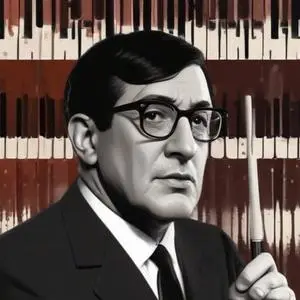
Bernard Herrmann: The Maestro of Melodic Magic
A Legendary Film Composer
Bernard Herrmann is renowned for his revolutionary film scores that continue to mesmerize audiences to this day. As a pioneer in the realm of cinematic music, he is widely regarded as one of the greatest film composers of all time, leaving an indelible mark on the world of cinema.
A Symphony of Collaborations
Herrmann's most iconic collaborations were with the master of suspense,
Alfred Hitchcock. Their partnership yielded some of the most unforgettable scores in cinematic history, including
The Man Who Knew Too Much (1956),
Vertigo (1958),
North by Northwest (1959),
Psycho (1960),
The Birds (1963), and
Marnie (1964). These scores not only elevated the films but also transformed the art of film composition.
A Radio Drama Pioneer
Before conquering the silver screen, Herrmann made a name for himself in radio drama, composing for
Orson Welles'
The Mercury Theater on the Air. This experience laid the foundation for his future work in film scoring, including his first film score for Welles' directorial debut,
Citizen Kane (1941).
A Versatile Maestro
Herrmann's impressive repertoire extends beyond his work with Hitchcock. He scored films like
Jane Eyre (1943),
Anna and the King of Siam (1946),
The Ghost and Mrs. Muir (1947),
The Day the Earth Stood Still (1951), and
Cape Fear (1962). He also ventured into television, composing for shows like
Have Gun – Will Travel and
Rod Serling's The Twilight Zone.
Influence on Modern Cinema
Herrmann's influence on modern cinema is undeniable. His unique harmonic and rhythmic vocabulary has inspired countless composers, including
François Truffaut, who sought him out to score
The Bride Wore Black (1968).
Brian De Palma also drew inspiration from Herrmann, collaborating with him on
Sisters (1972) and
Obsession (1976).
A Legacy of Magic
Bernard Herrmann's final score, recorded shortly before his passing, was for
Martin Scorsese's
Taxi Driver (1976). This swan song cemented his legacy as a master of melody and magic, leaving behind a treasure trove of cinematic scores that continue to enchant audiences.
Early Life and Career
Born Maximillian Herman on June 29, 1911, in New York City, Herrmann was the son of a Jewish middle-class family of Russian origin. He attended
DeWitt Clinton High School, where his passion for music first blossomed. His journey from a young prodigy to a legendary composer is a testament to his unwavering dedication to his craft.
Awards and Honors
Throughout his illustrious career, Herrmann received numerous accolades, including an Academy Award for
The Devil and Daniel Webster (1941). His contributions to the world of film music have been recognized and celebrated by generations of filmmakers, composers, and music lovers alike.
Personal Milestones and Key Life Events
- June 29, 1911: Born Maximillian Herman in New York City
- 1941: Wins Academy Award for The Devil and Daniel Webster
- 1956-1964: Collaborates with Alfred Hitchcock on several iconic films
- December 24, 1975: Passes away, leaving behind a legacy of melodic magic
Trivia and Fun Facts
- Herrmann made a cameo appearance as the conductor at Royal Albert Hall in The Man Who Knew Too Much (1956)
- He was known for his perfectionism, often rewriting scores until he was satisfied with the final result
- Herrmann's scores have been reused and reworked in numerous films, TV shows, and commercials, cementing his lasting impact on popular culture
FAQ
What is Bernard Herrmanns contribution to film music?
Bernard Herrmanns contribution to film music is immense, with iconic scores for Psycho, Vertigo, and Citizen Kane. His work revolutionized the art of film scoring and influenced generations of composers.
Who did Bernard Herrmann collaborate with in his career?
Bernard Herrmann collaborated with prominent directors like Alfred Hitchcock, Orson Welles, and François Truffaut, creating some of the most memorable soundtracks in cinema history.
What are some of Bernard Herrmanns notable compositions?
Some of Bernard Herrmanns notable compositions include his opera Wuthering Heights, the cantata Moby-Dick, and his scores for the films North by Northwest and Fahrenheit 451.
What awards did Bernard Herrmann receive for his work?
Bernard Herrmann received numerous awards, including an Academy Award for Best Original Score for All That Money Can Buy and a Grammy Award for Best Score from a Motion Picture or Television Show for his work on Taxi Driver.
What is Bernard Herrmanns legacy in the music world?
Bernard Herrmanns legacy in the music world is that of a trailblazing composer who pushed the boundaries of film scoring, inspiring countless musicians and composers with his innovative and evocative work.