


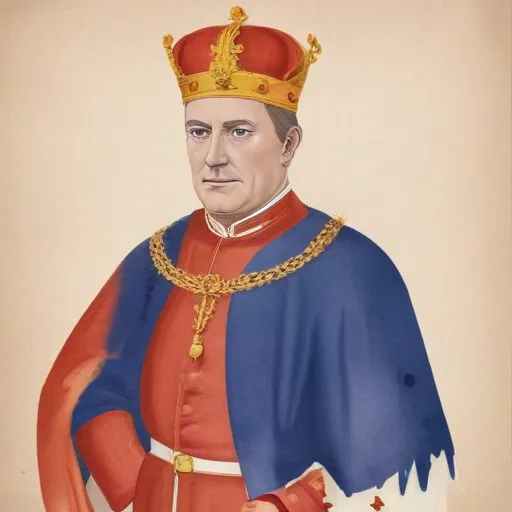
A 13th-century German nobleman who ruled Lippe and was a prominent military leader, known for his involvement in the Crusades and battles against the Bishop of Paderborn.
Bernard VII, Lord of Lippe, earned the nickname "The Bellicose" for his involvement in numerous bloody feuds throughout his life. He holds the distinction of being the longest-ever reigning European monarch, ruling the Lordship of Lippe from 1429 until his death in 1511.
Bernard VII was born on December 4, 1428, to Lord Simon IV of Lippe and his wife, Margaret of Brunswick-Grubenhagen. He inherited the Lordship of Lippe in 1429, before his first birthday, and stood under the regency and guardianship of his uncle Otto.
After Otto's death in 1446, Bernard's great-uncle Archbishop Dietrich II of Cologne was appointed regent. However, Bernard soon began to assert his independence and concluded a treaty with Duke Adolph I of Cleves-Mark in 1444, ceding a 50% share in the city of Lippstadt to Adolph. This move marked the beginning of his involvement in the Feud of Soest against Archbishop Dietrich II of Cologne.
In 1447, Dietrich II called in a Bohemian army, which devastated the countryside in Lippe and levelled the town of Blomberg to the ground. The Bohemians also besieged the cities of Lippstadt and Soest, but were unsuccessful. The feud was eventually settled in 1449, and Bernard took up residence at Blomberg Castle.
Bernard's life was marked by numerous feuds against various enemies, with shifting alliances. In 1469, he supported Landgrave Louis II, Landgrave of Lower Hesse, against his brother Henry III, Landgrave of Upper Hesse. However, in 1464, he supported his own brother, Prince-Bishop Simon III of Paderborn, against Louis II of Lower Hesse in the Hesse-Paderborn Feud about Calenberg Castle.
Bernard VII married Anna, the daughter of Count Otto II of Tecklenburg, and had several children. He expanded Detmold Castle, which at the time was the smallest city in Lippe, and moved his residence there in 1468. An inscription in the old castle tower, dated 1470, is a reminder of his architectural contributions.
Bernard VII's reign marked a significant period in the history of Lippe, during which he navigated complex alliances and feuds to maintain his power and influence. His legacy is one of strength and resilience, earning him a place in the annals of European history as the longest-ever reigning monarch.
Bernard VII, Lord of Lippe, left an indelible mark on European history through his lengthy reign, complex alliances, and numerous feuds. His legacy serves as a testament to the complexities of medieval politics and the resilience of strong leadership.
