


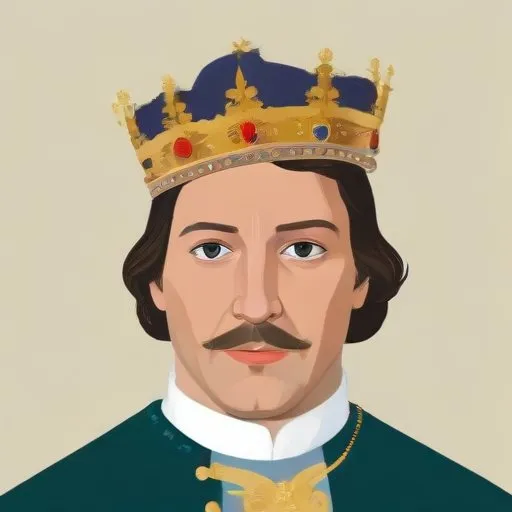
A 15th-century German nobleman who ruled Lower Hesse and played a significant role in the Imperial Diet, contributing to the development of the Holy Roman Empire. He's also known for his military campaigns and territorial expansions.
Louis II, also known as Louis the Frank, was a prominent figure in German history, renowned for his reign as the Landgrave of Lower Hesse from 1458 to 1471. During his tenure, he played a crucial role in shaping the destiny of the Landgraviate of Hesse, leaving an indelible mark on the region's politics, economy, and culture.
Born on September 7, 1438, Louis II was the son of Louis I, Landgrave of Hesse, and Anna of Saxony. Following his father's death, Louis II succeeded him as the Landgrave of Lower Hesse, while his brother Henry III inherited the Landgraviate of Upper Hesse.
In 1454, Louis II married Mechthild, daughter of Ludwig I, Count of Württemberg-Urach, and had four children:
Aside from his legitimate children, Louis II also had seven known illegitimate children with his mistress, Margarethe von Holzheim:
During his reign, Louis II was involved in a protracted dispute with his brother Henry III over the demarcation of their respective territories. The brothers eventually reached a settlement in May 1470, bringing an end to the conflict.
Louis II's legacy is marked by his efforts to consolidate power and establish the Landgraviate of Lower Hesse as a distinct entity. His reign laid the foundation for the future growth and development of the region, paving the way for his successors to build upon his accomplishments.
Though his life was cut short, dying on November 8, 1471, Louis II's impact on the history of Hesse remains significant, earning him a lasting place in the annals of German history.
Born in 1504
A German nobleman who ruled Hesse from 1509 to 1567, known for being a champion of the Protestant Reformation and a key figure in the Schmalkaldic League.
Born in 1469
A 15th-century German nobleman who ruled Hesse and played a significant role in the German Renaissance, known for his cultural and artistic patronage. He was a prominent figure in the Holy Roman Empire.
Born in 1244
A 13th-century German nobleman who ruled Hesse and was a key figure in the medieval Holy Roman Empire, known for his military campaigns and territorial expansions.
Born in 1402
Ruler of Hesse from 1277 to 1308, known for reorganizing the government and economy of his territory, and for his role in the imperial election of 1292.
Born in 1469
A 15th-century German nobleman who ruled Hesse and played a significant role in the German Renaissance, known for his cultural and artistic patronage. He was a prominent figure in the Holy Roman Empire.
Born in 1504
A German nobleman who ruled Hesse from 1509 to 1567, known for being a champion of the Protestant Reformation and a key figure in the Schmalkaldic League.
