


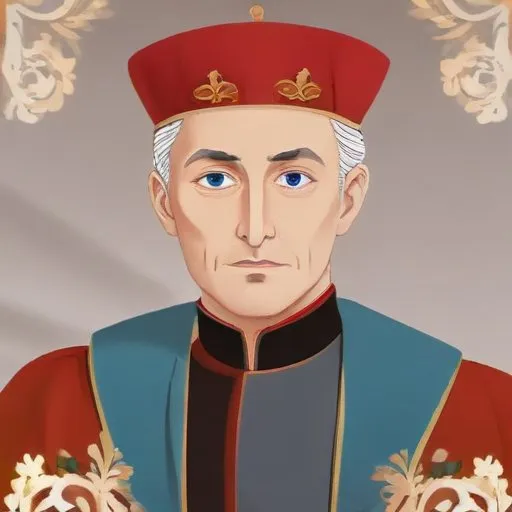
A German nobleman who ruled Hesse from 1509 to 1567, known for being a champion of the Protestant Reformation and a key figure in the Schmalkaldic League.
Philip I, Landgrave of Hesse, nicknamed "der Großmütige" (the Magnanimous), was a German nobleman and champion of the Protestant Reformation, leaving an indelible mark on the history of Germany. He was one of the most important early Protestant rulers in Germany, actively supporting Martin Luther and playing a crucial role in shaping the course of the Reformation.
Born on November 13, 1504, to Landgrave William II of Hesse and his second wife Anna of Mecklenburg-Schwerin, Philip's early life was marked by struggles over authority. His father's death when Philip was just five years old led to his mother becoming regent, but the power struggles continued. Declared of age in 1518, Philip began to assert his authority as a ruler, despite his imperfect education and neglected moral and religious training.
Philip's meeting with Martin Luther at the Diet of Worms in 1521, when he was just 17, proved to be a turning point. Although initially drawn to Luther's personality rather than his religious convictions, Philip later embraced Protestantism in 1524 after a personal meeting with the theologian Philipp Melanchthon. This pivotal moment set Philip on a path of actively supporting the Protestant cause.
Philip's leadership played a crucial role in shaping the Protestant Reformation in Germany. He helped suppress the German Peasants' War by defeating Thomas Muntzer at the Battle of Frankenhausen. By refusing to join the anti-Lutheran league of George, Duke of Saxony, in 1525, Philip demonstrated his commitment to the Protestant cause.
In 1526, Philip formed an alliance with John, Elector of Saxony, marking the beginning of a protective alliance of Protestant princes and powers. This strategic move helped to establish Philip as a key leader in the Protestant Reformation, earning him the respect and admiration of his contemporaries.
Philip's legacy extends far beyond his role as a Protestant champion. He was a skilled statesman who effectively navigated the complex web of alliances and rivalries that characterized 16th-century Germany. His commitment to the Protestant cause helped to establish Hesse as a bastion of Protestantism, earning him the nickname "der Großmütige" (the Magnanimous).
Philip's impact on modern society is still felt today. His role in shaping the Protestant Reformation continues to influence Protestant traditions around the world. His legacy serves as a testament to the power of leadership and conviction, inspiring generations to come.
Philip I, Landgrave of Hesse, was a complex and multifaceted individual whose impact on the Protestant Reformation continues to resonate today. His commitment to his faith, his leadership, and his vision for a unified Protestant Germany have cemented his place in history as one of the most important figures of the 16th century.
Born in 1483
A German monk and priest who sparked the Protestant Reformation, challenging Catholic Church authority and shaping Western Christianity. He's famous for nailing 95 theses to a church door, sparking a religious revolution.
Born in 1500
Ruling over a vast empire from 1519 to 1556, he was a powerful and influential leader who played a crucial role in shaping European politics and religion. He is most known for his efforts to unify Christian Europe and defend it against the Ottoman Empire.
Born in 1503
Elector of Saxony who played a key role in the Protestant Reformation and was a prominent leader of the Schmalkaldic League, a defensive alliance of Protestant states. He's also known for being captured and imprisoned by Emperor Charles V.
Born in 1441
German ruler of Saxony who introduced the Reformation and played a key role in the early Protestant movement, shaping the course of European history.
Born in 1463
A key figure in the early Protestant Reformation, he protected and supported Martin Luther, providing a safe haven for him to translate the Bible into German. He's also known for his role in establishing the University of Wittenberg.
Born in 1468
A key figure in the Protestant Reformation, he played a crucial role in establishing Lutheranism in Germany and was a strong supporter of Martin Luther. He's also known for his military campaigns against the Holy Roman Empire.
Born in 1471
A 15th-century German nobleman who ruled Saxony and was a key figure in the early Protestant Reformation, supporting Martin Luther's ideas and protecting him from persecution. He's also known for his cultural achievements, including commissioning artworks and founding the University of Wittenberg.
