


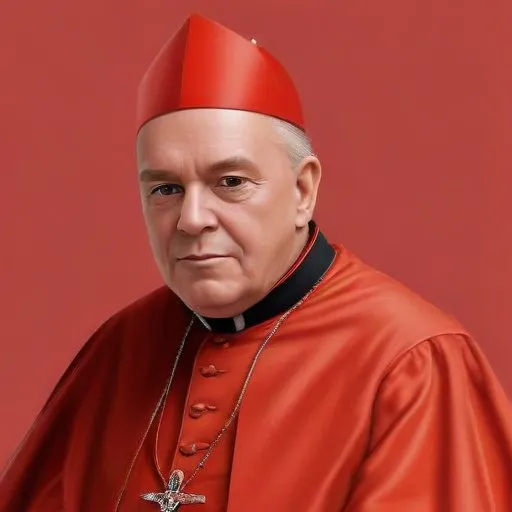
A prominent Catholic Church leader, he served as Archbishop of Utrecht and played a key role in the Second Vatican Council, shaping modern Catholicism.
Bernardus Johannes Alfrink was a prominent Dutch Cardinal of the Roman Catholic Church, renowned for his dedicated service as Archbishop of Utrecht from 1955 to 1975 and his elevation to the cardinalate in 1960. Throughout his illustrious career, he left an indelible mark on the Church, fostering a deeper understanding of Catholicism and promoting ecumenical dialogue.
Alfrink was born on July 5, 1900, in Nijkerk, Netherlands, to Theodorus Johannes Alfrink and Elisabeth Catharina Ossenvoort. Following his mother's passing in 1901, he was cared for by a childless aunt in Barneveld. He received his first Communion in 1911 and pursued his priestly vocation, enrolling in the minor seminary in Culemborg and later attending the seminary at Rijsenburg.
Alfrink was ordained to the priesthood on August 15, 1924, by Archbishop Henricus van de Wetering. He went on to complete his studies at the Pontifical Biblical Institute in Rome and the École Biblique in Jerusalem. He taught at the Seminary of Rijsenburg (1933-1945) and later at the Catholic University of Nijmegen (1945-1951), showcasing his commitment to education and theological inquiry.
On May 28, 1951, Alfrink was appointed Coadjutor Archbishop of Utrecht and Titular Archbishop of Tyana. He received his episcopal consecration on July 17, 1951, from Archbishop Paolo Giobbe, with Bishops Willem Lemmens and Jan Smit serving as co-consecrators. He succeeded Cardinal Johannes de Jong as Archbishop of Utrecht on October 31, 1955, and was named Apostolic Vicar of the Catholic Military Vicariate of the Netherlands on April 16, 1957.
Alfrink was created Cardinal-Priest of San Gioacchino ai Prati di Castello by Pope John XXIII in the consistory of March 28, 1960. As a cardinal, he played a significant role in shaping the Church's response to the challenges of the modern world. He actively contributed to scientific publications, led the Pax Christi movement in the Netherlands, and participated in the Second Vatican Council (1962-1965).
Throughout his distinguished career, Alfrink received various honors and accolades, including the Grand Cross in the Order of the Netherlands Lion. He passed away on December 17, 1987, leaving behind a rich legacy that continues to inspire and guide Catholics around the world.
Alfrink's tireless efforts to promote ecumenical dialogue, understanding, and cooperation have left a lasting impact on modern society. His commitment to education, scientific inquiry, and pastoral care has inspired generations of Catholics and non-Catholics alike.
Born in 1881
Reformed the Catholic Church, introducing progressive reforms and ecumenical dialogue, and convened the Second Vatican Council.
Born in 1417
A 15th-century pope who played a significant role in the fall of the Western Schism, ending the division in the Catholic Church. He's also known for his lavish spending and nepotism.
Born in 1920
Leader of the Catholic Church from 1978 to 2005, known for helping to end communism in Poland and being a charismatic advocate for human rights and social justice.
Born in 1920
Leader of the Catholic Church from 1978 to 2005, known for helping to end communism in Poland and being a charismatic advocate for human rights and social justice.
99 Years Old
The first pope to resign in nearly 600 years, he's known for his conservative views and efforts to strengthen the Catholic Church's traditional teachings. He's also a prolific writer and theologian.
89 Years Old
The leader of the Catholic Church, known for his progressive stance on social issues and efforts to reform the Church, inspiring millions worldwide.
