


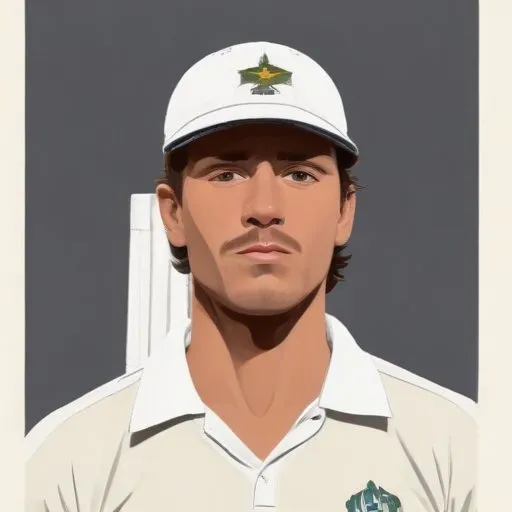
Australian left-arm spinner who took 74 wickets in 14 Tests, known for his unorthodox bowling action and ability to extract turn from even the most docile pitches.
Known for being the second-oldest Test cricketer in history, Bert Ironmonger, an Australian cricketer, defied age and expectations, playing Test cricket from 1928 to 1933, culminating in his final Test match at the remarkable age of 50.
Born on April 7, 1882, in Pine Mountain, near Ipswich, Queensland, Ironmonger was the youngest of ten children of a farmer. His life took a dramatic turn at a young age when he lost the forefinger of his left hand, his bowling hand, in an industrial accident.
Despite this setback, Ironmonger's passion for cricket only grew stronger. He played for the Albert club in Ipswich for 15 years, taking an astonishing 1000 wickets at an average of fewer than six runs each.
Ironmonger made his first-class debut for Queensland at the age of 27, and soon moved to Victoria in 1914, accepting a position as professional bowler at the Melbourne Cricket Club. In a remarkable display of skill, he took 9 for 30 against St Kilda in his second match for Melbourne, earning him an immediate selection to play for Victoria.
In the 1914-1915 season, Ironmonger emerged as the outstanding bowler in the Sheffield Shield, taking 32 wickets in Victoria's four matches at an average of 17.12. His impressive performance led Victoria to win the competition, and he also topped the wicket-takers list in the Melbourne competition that season.
After World War I, Ironmonger resumed his cricket career, albeit hampered by injuries to his knees. Despite this, he continued to impress, taking 45 wickets on the Australian team's tour to New Zealand in the 1920-1921 season at an average of 13.17.
Ironmonger's perseverance and skill eventually earned him a spot in the Australian Test team, where he played from 1928 to 1933, becoming the second-oldest Test cricketer in history.
Bert Ironmonger's remarkable cricket career, spanning over four decades, is a testament to his dedication, perseverance, and unparalleled passion for the sport. His achievements continue to inspire generations of cricketers, earning him a revered place in the annals of Australian cricket history.
Ironmonger's unwavering passion for cricket and his remarkable achievements have cemented his place as one of the most iconic figures in Australian cricket history.
Born in 1908
A cricket legend and iconic figure in Australian sports, renowned for his incredible batting skills and unbeaten record, earning him the nickname "The Don".
Born in 1900
Australian sports legend who dominated cricket with record-breaking batting averages and also excelled in baseball, earning him a place in the Australian Cricket Hall of Fame.
Born in 1891
A pioneering leg-spinner who took 216 wickets in 37 Tests, known for his unorthodox style and ability to spin the ball both ways. He is considered one of the greatest bowlers in cricket history.
77 Years Old
Conservative commentator and bestselling author known for his provocative opinions and fiery debates on politics and current events.
Born in 1922
A pioneering batsman and cricket commentator, known for his aggressive playing style and iconic broadcasting voice.
Born in 1916
Australian opening batsman who played 13 Tests between 1945 and 1948, known for his aggressive style and strong performances against England.
Born in 1913
Australian cricket legend and commentator, known for his exceptional batting skills and charismatic broadcasting style. He's a beloved figure in Australian sports history.
97 Years Old
A highly skilled and aggressive left-handed batsman, known for his impressive career statistics and dominant performances in the 1940s and 1950s.
