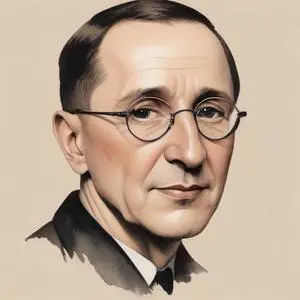
Bertolt Brecht: The Visionary of Epic Theatre
A Life Dedicated to Challenging the Status Quo
Bertolt Brecht was a German theatre practitioner, playwright, and poet who revolutionized the world of theatre with his unique approach to storytelling. He is best known for his pioneering work in epic theatre, a genre that aimed to challenge the audience's perceptions and spark critical thinking.
Early Life and Influences
Born on February 10, 1898, in Augsburg, Germany, Brecht was raised in a modest household with a Protestant mother and a Catholic father. His maternal grandparents, who lived next door, were Pietists and played a significant role in shaping Brecht's early life. The Bible, which he was familiar with from a young age, would later influence his writing.
The Formative Years
Brecht's early years were marked by a fascination with theatre and poetry. He wrote his first plays while still in high school, and his early work was heavily influenced by the First World War. His experiences during this period shaped his worldview and laid the foundation for his later work.
The Rise of Epic Theatre
In the 1920s, Brecht began to develop his signature style, which he dubbed "epic theatre." This genre rejected the traditional Aristotelian approach to theatre, instead aiming to engage the audience in a more intellectual and emotionally detached way. Brecht's epic theatre was characterized by its use of alienation techniques, such as abrupt scene changes and direct address to the audience.
The Threepenny Opera and Collaboration with Kurt Weill
One of Brecht's most famous works,
The Threepenny Opera, was written in collaboration with composer
Kurt Weill in 1928. This groundbreaking musical introduced Brecht's epic theatre to a wider audience and cemented his reputation as a visionary playwright.
Marxist Influences and Exile
Brecht's fascination with Marxist theory led him to write didactic plays, or "Lehrstücke," during the 1920s and 1930s. As the Nazi Party rose to power, Brecht's Marxist leanings made him a target, and he was forced into exile. He fled to Scandinavia and later to the United States, where he continued to write and teach.
Surveillance and McCarthyism
During his time in the United States, Brecht was surveilled by the FBI, and in 1947, he was subpoenaed by the House Un-American Activities Committee. This experience had a profound impact on Brecht, and he eventually returned to East Berlin, where he established the Berliner Ensemble with his wife, Helene Weigel.
Legacy and Impact
Brecht's influence on modern theatre is immeasurable. His epic theatre has inspired generations of playwrights and directors, from
Samuel Beckett to
Peter Brook. Brecht's commitment to challenging the status quo and sparking critical thinking has made him a lasting figure in the world of theatre.
Quotes and Memorable Sayings
- "Art is not a mirror held up to reality, but a hammer with which to shape it."
- "Theatre is the art of looking at people looking at people."
Awards and Honors
Brecht was awarded the Stalin Peace Prize in 1954, a testament to his commitment to promoting peace and social justice through his work.
Personal Relationships and Anecdotes
Brecht's marriage to
Helene Weigel was a partnership that lasted a lifetime. Weigel, a talented actress, was not only Brecht's wife but also his collaborator and muse. Together, they founded the Berliner Ensemble, which became a hub for innovative theatre in East Berlin.
Trivia and Fun Facts
- Brecht was an avid collector of books and had a personal library of over 5,000 volumes.
- He was known for his love of cigars and was rarely seen without one.
Inspirational Stories and Motivations
Brecht's life was a testament to his unwavering commitment to his art and his vision for a better world. Despite facing exile, surveillance, and criticism, Brecht remained true to himself and his ideals, inspiring generations of artists and thinkers to follow in his footsteps.
FAQ
What is Bertolt Brechts most famous play?
Bertolt Brechts most famous play is Mother Courage and Her Children, a classic of 20th-century theatre that explores the consequences of war and capitalism.
Who influenced Bertolt Brechts avant-garde style?
Bertolt Brechts avant-garde style was influenced by various artists, including Erwin Piscator, Vsevolod Meyerhold, and Karl Valentin, as well as the Dada and Surrealist movements.
What was Bertolt Brechts role in the development of epic theatre?
Bertolt Brecht was a pioneer of epic theatre, a genre that emphasizes the social and political context of a story over emotional identification with characters. He developed this style in collaboration with composer Kurt Weill and others.
What are some of Bertolt Brechts notable poems?
Bertolt Brecht was a prolific poet, and some of his notable works include Mahagonny Songspiel, The Threepenny Opera, and The Jungle of Cities.
How did Bertolt Brechts experience in World War I shape his writing?
Bertolt Brechts experience in World War I had a profound impact on his writing, leading him to question the mythology of war and the role of the individual in society.