


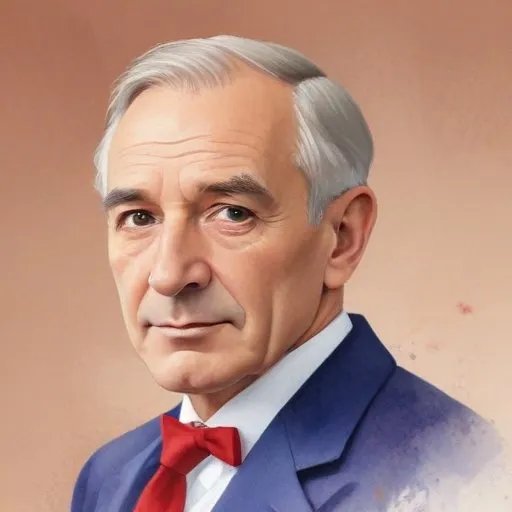
Developed neutron spectroscopy, a technique used to study the behavior of atoms and molecules, earning him the Nobel Prize in Physics in 1994.
When it comes to pioneering contributions in the development of neutron scattering techniques for studying condensed matter, one name that stands out is Bertram Neville Brockhouse, a Canadian physicist who shared the 1994 Nobel Prize in Physics with Clifford Shull. This prestigious award was a testament to Brockhouse's groundbreaking work in the field, which has had a profound impact on our understanding of the behavior of materials at the atomic and molecular level.
Born on July 15, 1918, in Lethbridge, Alberta, Canada, Brockhouse came from a family of English descent. He pursued his academic interests at the University of British Columbia, where he earned his Bachelor's degree in 1947. He then moved on to the University of Toronto, where he secured his Master's degree in 1948 and Ph.D. in 1950.
Brockhouse's research career spanned over three decades, during which he made significant contributions to the development of neutron spectroscopy. From 1950 to 1962, he worked at Atomic Energy of Canada's Chalk River Nuclear Laboratory, where he collaborated with P. K. Iyengar, a pioneer in India's nuclear program. In 1962, he joined McMaster University in Canada as a professor, a position he held until his retirement in 1984.
Brockhouse's outstanding contributions to science were recognized with numerous awards and honors. He was elected a Fellow of the Royal Society (FRS) in 1965 and was appointed an Officer of the Order of Canada in 1982. He was later promoted to Companion in 1995. In addition to the Nobel Prize in Physics, which he shared with Clifford Shull in 1994, Brockhouse was also honored with a medal created by the Division of Condensed Matter and Materials Physics (DCMMP) and the Canadian Association of Physicists (CAP) in 1999.
Brockhouse's legacy extends beyond his research and awards. He has inspired generations of scientists and researchers in the field of condensed matter physics. In recognition of his contributions, McMaster University renamed a street on its campus "Brockhouse Way" in 2005. The town of Deep River, Ontario, has also named a street in his honor.
Through his remarkable work, Bertram Brockhouse has left an indelible mark on the field of condensed matter physics. His pioneering contributions to neutron scattering techniques continue to inspire and influence scientists around the world.
Born in 1913
Developed theories on quantum electrodynamics and the behavior of hydrogen atoms, earning a Nobel Prize in Physics in 1955.
Born in 1918
A brilliant physicist and engineer who pioneered quantum mechanics and famously explained complex concepts in simple terms, making science accessible to all.
97 Years Old
A pioneer in particle physics, discovering subatomic particles like quarks and gluons, and developing the theory of quantum chromodynamics.
Born in 1906
A renowned physicist and Nobel laureate who made groundbreaking contributions to our understanding of the universe, particularly in the fields of nuclear physics and astrophysics.
Born in 1901
A pioneer in nuclear physics, known for leading the team that developed the first nuclear reactor and playing a crucial role in the development of the atomic bomb.
Born in 1920
A Nobel Prize-winning physicist who discovered antiprotons, a fundamental particle in the universe, and made significant contributions to our understanding of subatomic particles.
Born in 1904
Leading the development of the atomic bomb during World War II, this brilliant mind made groundbreaking contributions to theoretical physics, pushing the boundaries of human understanding.
