


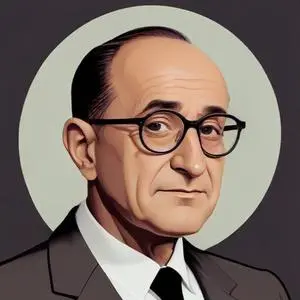
A pioneer in nuclear physics, known for leading the team that developed the first nuclear reactor and playing a crucial role in the development of the atomic bomb.
Enrico Fermi, the Italian-American physicist, is renowned for his groundbreaking work in creating the world's first nuclear reactor, the Chicago Pile-1, and his pivotal role in the Manhattan Project. His legacy as the "architect of the nuclear age" and the "architect of the atomic bomb" is a testament to his unparalleled contributions to the field of physics.
Born on September 29, 1901, in Rome, Italy, Fermi was raised in a family of modest means. His fascination with physics began at a young age, and he went on to study at the University of Pisa, where he earned his Ph.D. in 1926. His early work focused on statistical mechanics, and he quickly made a name for himself in the scientific community.
Fermi's work in both theoretical and experimental physics was unparalleled. He made significant contributions to the development of statistical mechanics, quantum theory, and nuclear and particle physics. His application of the exclusion principle to an ideal gas, now known as Fermi-Dirac statistics, is a fundamental concept in modern physics.
Fermi's theory of beta decay, which incorporated the concept of the neutrino, described one of the four fundamental interactions in nature. His work on the weak interaction, now referred to as Fermi's interaction, paved the way for a deeper understanding of the fundamental forces of nature.
Fermi's experiments with neutron-induced radioactivity led to the discovery that slow neutrons were more easily captured by atomic nuclei than fast ones. The Fermi age equation, developed to describe this phenomenon, is still used today to calculate the age of radioactive samples.
Fermi's work was recognized with the 1938 Nobel Prize in Physics for his work on induced radioactivity by neutron bombardment and for the discovery of transuranium elements. He also received the Max Planck Medal in 1954, just months before his passing.
Fermi's work had a profound impact on modern society, paving the way for the development of nuclear power and atomic energy. His legacy extends beyond the scientific community, influencing popular culture and shaping our understanding of the fundamental forces of nature.
Fermi's work on nuclear reactors and atomic energy has had a lasting impact on the global energy landscape. His contributions to the development of nuclear power have enabled the creation of clean and sustainable energy sources, reducing our reliance on fossil fuels.
Fermi's work was often compared to that of his contemporaries, including Albert Einstein and Niels Bohr. While they made significant contributions to theoretical physics, Fermi's unique ability to excel in both theoretical and experimental physics set him apart.
Fermi married Laura Capon in 1928, and they had two children together. He became a naturalized American citizen in 1939. Fermi's personal life was marked by simplicity and humility, despite his immense fame and recognition.
Fermi passed away on November 28, 1954, leaving behind a legacy that continues to shape our understanding of the physical world. His work remains a testament to the power of human curiosity and innovation, inspiring generations of scientists and scholars.
"When I am working on a problem, I never think about beauty. Only about how to solve the problem." - Enrico Fermi
Fermi's legacy is a reminder that the pursuit of knowledge and innovation is a never-ending journey, driven by humanity's innate curiosity and passion for discovery.
Born in 1898
A pioneer in nuclear physics, known for conceiving the idea of a nuclear chain reaction and patenting the concept of a nuclear reactor. He also played a key role in persuading Einstein to warn Roosevelt about the possibility of Germany developing an atomic bomb.
Born in 1902
A Hungarian physicist and mathematician who made groundbreaking contributions to quantum mechanics and nuclear physics, and was awarded the Nobel Prize in Physics in 1963.
Born in 1918
A brilliant physicist and engineer who pioneered quantum mechanics and famously explained complex concepts in simple terms, making science accessible to all.
Born in 1903
Pioneering mathematician and physicist who developed the concept of the modern computer architecture and made significant contributions to quantum mechanics and game theory. His work laid the foundation for modern computing and artificial intelligence.
Born in 1901
Invented the cyclotron, a type of particle accelerator, revolutionizing nuclear physics and paving the way for major breakthroughs in medicine, energy, and materials science.
Born in 1912
A pioneering experimental physicist who disproved a fundamental concept in physics, the law of parity, and made groundbreaking contributions to particle physics.
