


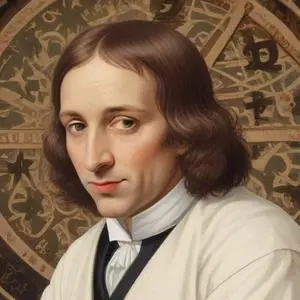
A 17th-century genius who made major contributions to mathematics, physics, and philosophy, inventing the mechanical calculator and developing the theory of probability. His writings also explored the human condition and faith.
Blaise Pascal, the French mathematician, physicist, and philosopher, is best known for his contributions to the development of modern economics, social science, and the invention of the mechanical calculator. His groundbreaking work on projective geometry, conic sections, and probability theory has made him a household name in the world of science.
Born on June 19, 1623, in Clermont-Ferrand, France, Pascal was a child prodigy who showed exceptional mathematical abilities from an early age. His father, Étienne Pascal, a tax collector in Rouen, recognized his son's talent and took it upon himself to educate him at home.
Pascal's earliest mathematical work was on projective geometry, and at the age of 16, he wrote a significant treatise on conic sections. He later corresponded with Pierre de Fermat on probability theory, which laid the foundation for modern economics and social science.
In 1642, Pascal started working on calculating machines, which he called "Pascalines." These machines were able to perform basic arithmetic operations, and they established him as one of the first two inventors of the mechanical calculator.
In addition to his mathematical contributions, Pascal was a prolific philosopher and writer. He wrote in defense of the scientific method and produced several controversial results. His most famous works, "Lettres provinciales" and "Pensées," date back to 1654, when he had a religious experience that led him to write about philosophy and theology.
One of Pascal's most famous philosophical arguments is the "Wager," also known as the "Discourse on the Machine." This fideistic probabilistic argument for God's existence suggests that it is rational to believe in God, even if there is no concrete evidence, because the potential reward of eternal life outweighs the possible loss of finite pleasure.
Pascal's work has had a profound impact on modern society. His contributions to mathematics, physics, and philosophy have influenced generations of scientists, thinkers, and writers. His mechanical calculator paved the way for the development of modern computers, and his philosophical works continue to inspire and challenge people to this day.
Pascal's work on fluid dynamics, pressure, and vacuum has had a lasting impact on the study of physics and engineering. His experiments with the cycloid and its use in calculating the volume of solids have also contributed significantly to the field of mathematics.
Pascal was a devout Catholic and identified with the Jansenist movement within Catholicism. He was close to his sister, Jacqueline, who shared his religious views. Although he lived a relatively short life, dying on August 19, 1662, at the age of 39, Pascal's legacy continues to inspire and influence people around the world.
In conclusion, Blaise Pascal was a true polymath, whose contributions to mathematics, science, and philosophy have left a lasting impact on modern society. His legacy continues to inspire and challenge people to this day, and his work remains a testament to the power of human ingenuity and creativity.
Born in 1596
Developed influential philosophical and mathematical concepts, including the famous phrase "I think, therefore I am," and laid the foundation for modern Western philosophy.
Born in 1629
A 17th-century polymath who made groundbreaking contributions to optics, probability theory, and astronomy, including the discovery of Saturn's rings and the largest moon, Titan.
Born in 1646
Developed calculus independently of Isaac Newton, and made major contributions to the fields of philosophy, politics, and history.
Born in 1564
Pioneering astronomer, physicist, and mathematician who played a major role in the Scientific Revolution, making key discoveries that challenged Aristotelian views and laid the foundation for modern science.
Born in 1588
A 17th-century polymath who made significant contributions to mathematics, particularly in the discovery of prime numbers, and wrote extensively on philosophy and theology.
