


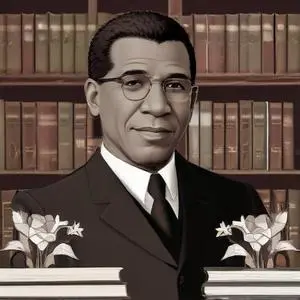
A pioneering figure in African-American education, he founded the Tuskegee Institute and advocated for racial uplift through self-improvement and economic empowerment. His autobiography, "Up from Slavery," remains a classic of American literature.
Booker T. Washington is renowned for his trailblazing role in shaping the African American experience through education, entrepreneurship, and diplomacy. As a former slave, he rose to become a prominent leader, author, and orator, dedicating his life to promoting self-reliance and economic empowerment among his people.
Born on April 5, 1856, in Hales Ford, Virginia, Washington was freed from slavery during the Civil War. He went on to attend Hampton Normal and Agricultural Institute, where he worked as a janitor to pay for his tuition. This early display of determination and resourcefulness would become a hallmark of his life's work. Later, he attended Wayland Seminary, further solidifying his commitment to education.
In 1881, Washington was appointed the first leader of the Tuskegee Institute in Alabama, an institution dedicated to providing higher education to African Americans. Through his tireless efforts, the institute flourished, with students actively participating in the construction of buildings, fostering a sense of community and self-sufficiency. This innovative approach earned him national recognition, particularly after his landmark Atlanta Address of 1895, which garnered attention from politicians and the public alike.
Washington's contributions were recognized with numerous accolades, including honorary degrees from Harvard University and Dartmouth College. His influence extended beyond the United States, with international leaders and dignitaries seeking his counsel and guidance.
Booker T. Washington's remarkable life was cut short on November 14, 1915, when he passed away in Tuskegee, Alabama. However, his legacy continues to inspire generations, reminding us of the power of education, perseverance, and community empowerment. As a testament to his enduring impact, the Tuskegee Institute remains a thriving institution, a beacon of hope and opportunity for African American students seeking a brighter future.
" Casting down your bucket among these people, casting it down in making friends with every man, but it will not do to cast it down among the thirteen million of the Negro race and catch it among the two hundred thousand or more that might be called the talented tenth. In order to succeed we must get the negro to move in the direction of the civilized and the cultured, regardless of the colour of the man who leads him."
Washington's life serves as a powerful reminder of the transformative power of education, entrepreneurship, and leadership, leaving an indelible mark on American history and continue to inspire generations to strive for a more equitable and just society.
Born in 1868
A pioneering figure in the struggle for racial equality, advocating for civil rights and social justice through groundbreaking research and powerful writings.
Born in 1862
A pioneering African American journalist and anti-lynching crusader who exposed the horrors of racial violence in the South through her writing and activism.
Born in 1908
A trailblazing lawyer and civil rights champion who broke racial barriers in the US justice system, serving as the first African American on the Supreme Court. He fought tirelessly for equality and justice, leaving a lasting impact on American history.
97 Years Old
A prominent leader in the civil rights movement, advocating for racial equality and social justice through nonviolent means, leaving a lasting impact on American history.
Born in 1926
A prominent leader in the American Civil Rights Movement, he worked closely with Martin Luther King Jr. to advocate for racial equality and social justice through nonviolent means.
Born in 1902
A renowned poet, novelist, and playwright who powerfully voiced the experiences and struggles of African Americans during the Harlem Renaissance, using jazz and blues rhythms to convey the spirit of his people.
Born in 1891
A celebrated author and anthropologist who explored African-American culture through novels, stories, and folklore, particularly in the rural South during the early 20th century.
