


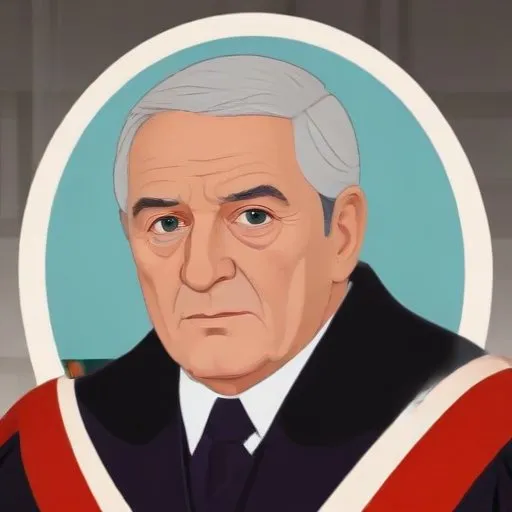
A prominent jurist who served as Lord Chief Justice of Northern Ireland, known for leading a high-profile inquiry into the death of a government scientist. His report's conclusions were highly controversial and sparked widespread debate.
Brian Hutton, Baron Hutton, is best known for his pivotal roles in several high-profile cases that shook the foundations of the British legal system. As the Lord Chief Justice of Northern Ireland and later, a Lord of Appeal in Ordinary, Hutton's decisions sparked both praise and controversy, leaving an indelible mark on the country's judicial landscape.
Born in Belfast in 1932, Hutton's academic prowess earned him a scholarship to Shrewsbury School and later, Balliol College, Oxford, where he graduated with a degree in jurisprudence in 1953. He returned to Belfast to study law at Queens University, being called to the Bar of Northern Ireland in 1954.
Hutton's career in law was marked by rapid advancement. He became a Queens Counsel in 1970 and served as junior counsel to the Attorney General for Northern Ireland from 1969. His appointment as a High Court judge in 1979 marked the beginning of his rise to prominence in the legal circles.
Throughout his career, Hutton's decisions have had far-reaching consequences, shaping the course of British legal history. While some have criticized his judgments as being overly conservative, others have praised his commitment to upholding the law. As a Lord of Appeal in Ordinary, Hutton's influence extended beyond Northern Ireland, contributing to the development of British law as a whole.
In recognition of his service, Hutton was granted a life peerage as Baron Hutton, of Bresagh in the County of Down, in 1997.
Little is known about Hutton's personal life, but his dedication to the legal profession is evident in his impressive career trajectory. His passing on July 14, 2020, marked the end of an era in British legal history, leaving behind a legacy that continues to inspire and provoke debate.
82 Years Old
A Northern Irish lawyer and politician who played a crucial role in the Good Friday Agreement, earning him a Nobel Peace Prize in 1998. He served as the first First Minister of Northern Ireland, working to establish a power-sharing government.
73 Years Old
The former Prime Minister of the United Kingdom who led the country through a transformative period, including the Iraq War, and is known for his charismatic leadership and controversial decisions.
Born in 1926
A firebrand Protestant leader who played a key role in Northern Ireland's turbulent politics, known for his strong anti-Catholic stance and later, his surprising shift towards power-sharing.
73 Years Old
A British politician who played a key role in the Northern Ireland peace process and served in various UK cabinet positions, known for his diplomatic efforts and Labour Party leadership.
83 Years Old
A former Prime Minister of the United Kingdom, he led the country from 1990 to 1997, playing a key role in shaping the nation's economy and foreign policy during a tumultuous period.
75 Years Old
The Prime Minister of the United Kingdom from 2007 to 2010, known for his key role in shaping the country's economy and response to the 2008 global financial crisis.
