


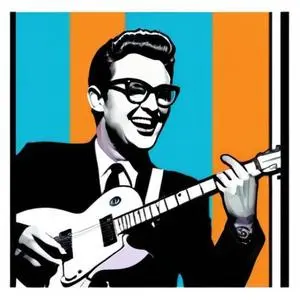
Pioneering rock 'n' roll musician and songwriter who blended country, rockabilly, and rhythm & blues to create a unique sound, influencing many famous bands.
Buddy Holly, known as the "Father of Rock 'n' Roll," was an American singer, songwriter, and musician who revolutionized the music industry in the 1950s with his unique blend of rockabilly, country, and rhythm and blues. With hits like "That'll Be the Day" and "Peggy Sue," Holly's music captured the hearts of millions, paving the way for future rock 'n' roll legends.
Born Charles Hardin Holley on September 7, 1936, in Lubbock, Texas, Holly grew up in a musical family during the Great Depression. He learned to play guitar and sing alongside his siblings, influenced by gospel music, country music, and rhythm and blues acts.
In 1952, Holly made his first appearance on local television, and the following year, he formed the group Buddy and Bob with his friend Bob Montgomery. After opening for Elvis Presley in 1955, Holly decided to pursue a career in music, shifting his band's style from country and western to entirely rock and roll.
In October 1955, when Holly opened for Bill Haley and His Comets, he was spotted by Nashville scout Eddie Crandall, who helped him get a contract with Decca Records. However, unhappy with the producer's musical style and control, Holly went to producer Norman Petty in Clovis, New Mexico, and recorded a demo of "That'll Be the Day," among other songs.
Petty became Holly's manager and sent the demo to Brunswick Records, which released it as a single credited to The Crickets, which became the name of Holly's band. In September 1957, as the band toured, "That'll Be the Day" topped the US and UK singles charts, followed by another major hit, "Peggy Sue," in October.
In January 1958, Holly made his second appearance on The Ed Sullivan Show, and soon after, he toured Australia and the UK. In early 1959, he assembled a new band, consisting of future country music star Waylon Jennings, and embarked on a tour of the Midwest.
Tragically, Holly's life was cut short in a plane crash on February 3, 1959, at the age of 22, along with Ritchie Valens and J.P. "The Big Bopper" Richardson. His music, however, continued to inspire generations of musicians, including The Beatles, The Rolling Stones, and Bob Dylan.
Holly was inducted into the Rock and Roll Hall of Fame in 1986 and has a star on the Hollywood Walk of Fame. He received a Grammy Lifetime Achievement Award in 1997 and was ranked 13th on Rolling Stone's 100 Greatest Artists of All Time.
"The music was the most important thing, and that's what I always tried to do – make good music."
"I'm not a businessman, I'm a musician. I don't want to be involved in the business side of it."
Buddy Holly's innovative style and music paved the way for future rock 'n' roll legends, influencing the development of rock music and inspiring generations of musicians. His legacy continues to be celebrated through his music, films, and memorabilia.
Holly's music also transcended racial and cultural boundaries, helping to break down barriers in the segregated South during the 1950s. His music was played on both white and black radio stations, making him one of the first white artists to appeal to a predominantly black audience.
Buddy Holly's short but remarkable career coincided with a pivotal moment in American history, as the country was transitioning from the post-war era to the tumultuous 1960s. His music captured the spirit of the times, reflecting the energy, optimism, and rebelliousness of the youth culture.
Holly's legacy extends beyond his music, serving as a symbol of the power of creativity, innovation, and perseverance. His influence can be seen in the many musicians who followed in his footsteps, from The Beatles to Bob Dylan, and continues to inspire new generations of artists.
91 Years Old
The "King of Rock and Roll" was a music and cultural icon, known for his charismatic stage presence, distinctive voice, and hits like "Hound Dog" and "Jailhouse Rock".
Born in 1926
Rock 'n' roll pioneer who wrote and performed iconic hits like "Johnny B. Goode" and "Maybellene", blending country, blues, and rhythm to create a unique sound.
93 Years Old
A flamboyant and charismatic rock 'n' roll pioneer, known for hits like "Tutti Frutti" and "Good Golly Miss Molly", blending gospel, blues, and boogie-woogie styles.
91 Years Old
A rock 'n' roll pioneer, known for his energetic stage performances and hits like "Great Balls of Fire" and "Whole Lotta Shakin' Goin' On".
86 Years Old
Legendary musician and peace activist who co-founded the Beatles, one of the most influential and successful bands in the history of popular music.
84 Years Old
Legendary musician and songwriter behind iconic bands and solo hits, shaping the course of popular music with enduring classics like "Yesterday" and "Hey Jude".
83 Years Old
Lead guitarist of the Beatles, successful solo artist, and innovative film producer, known for his iconic songs and philanthropic efforts.
86 Years Old
A legendary musician and entertainer, best known for being the drummer for the iconic rock band The Beatles, and later a successful solo artist and actor.
