


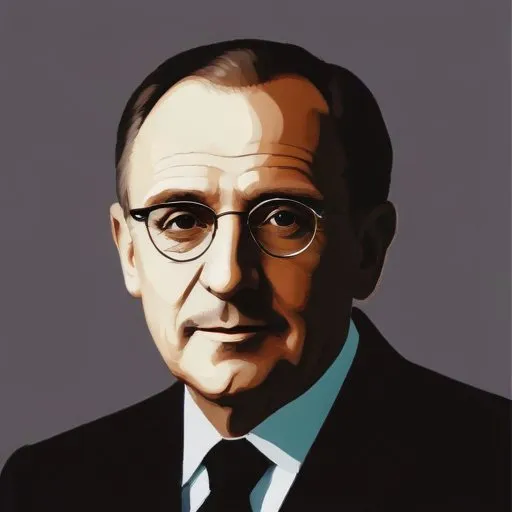
Developed a unified field theory that attempted to merge quantum mechanics and general relativity, and was known for his work on gravitational theory and its potential applications.
Burkhard Heim, a German theoretical physicist, is renowned for developing a unified field theory, known as Heim theory, which has far-reaching implications for hyperspace travel. His groundbreaking work has captivated scientists and theorists alike, offering a glimpse into the possibility of traversing vast distances in a relatively short period.
Born on February 9, 1925, Heim's life was marked by adversity, including a devastating laboratory accident in 1944 that left him without hands and mostly deaf and blind. Despite these challenges, Heim persevered, undergoing the Krukenberg Procedure and adapting to his new circumstances.
Heim's passion for physics led him to register at the University of Göttingen, where he began his academic journey. In 1943, he met renowned physicist Werner Heisenberg, who was impressed by Heim's innovative approach to creating a clean hydrogen bomb at the tender age of 18. This encounter would have a lasting impact on Heim's work.
In 1952, Heim presented his revolutionary theory for interplanetary propulsion at the International Astronautical Federation (IAF) in Stuttgart, Germany. This landmark presentation introduced the concept of treating gravitational, electromagnetic, weak, and strong forces as distortions of their proper Euclidean metrics in a higher-dimensional space.
Heim's theory, which combines aspects of general relativity, quantum mechanics, and electromagnetic theory, offers a holistic understanding of the universe. By recognizing the interconnectedness of these forces, Heim's work paves the way for the development of advanced propulsion systems.
Heim's contributions to theoretical physics have inspired generations of scientists, engineers, and theorists. His work has sparked intense debate and exploration, pushing the boundaries of human understanding and fueling imagination.
Heim's theory is not only a scientific endeavor but also a philosophical one. By questioning the fundamental nature of space and time, Heim's work encourages us to reevaluate our understanding of the cosmos and humanity's place within it.
Burkhard Heim's remarkable journey, marked by both challenges and triumphs, serves as a testament to the power of human ingenuity and determination. As we continue to explore the mysteries of the universe, Heim's legacy inspires us to push beyond the boundaries of human knowledge, reaching for the stars and beyond.
Born in 1901
A pioneer in quantum mechanics, he formulated the uncertainty principle, which revolutionized our understanding of the atomic world. His groundbreaking work reshaped modern physics.
Born in 1885
A pioneer in quantum mechanics, he introduced the concept of wave-particle duality, revolutionizing our understanding of atomic structure. His philosophical approach to science also explored the nature of reality and human understanding.
Born in 1879
A brilliant physicist who developed the theory of relativity and is considered one of the most influential scientists of the 20th century, known for his groundbreaking work in physics and mathematics.
Born in 1858
A pioneer in quantum theory, he introduced the concept of the Planck constant, revolutionizing our understanding of energy and matter.
Born in 1892
A French physicist and Nobel laureate who proposed that particles, such as electrons, can exhibit wave-like behavior, revolutionizing quantum mechanics. His hypothesis led to major breakthroughs in understanding the atomic structure.
Born in 1902
A brilliant mind who formulated the Dirac equation, a fundamental concept in quantum mechanics, and predicted the existence of antimatter. His work revolutionized our understanding of the universe.
Born in 1918
A brilliant physicist and engineer who pioneered quantum mechanics and famously explained complex concepts in simple terms, making science accessible to all.
