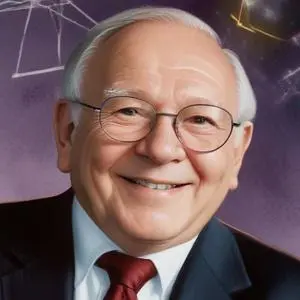
Burton Richter: The Physicist Who Revolutionized Particle Physics
Burton Richter, a renowned American physicist, is best known for leading the Stanford Linear Accelerator Center (SLAC) team that co-discovered the J/ψ meson, a groundbreaking finding that earned him the Nobel Prize in Physics in 1976. This milestone achievement, alongside Samuel Ting's Brookhaven National Laboratory team, marked a significant breakthrough in particle physics, later dubbed the "November Revolution."
Early Life and Education
Born on March 22, 1931, in Brooklyn, New York, Richter was raised in the Queens neighborhood of Far Rockaway. He came from a Jewish family, with his parents, Fanny Pollack and Abraham Richter, a textile worker, instilling in him a passion for learning. Richter attended Far Rockaway High School, a breeding ground for future Nobel laureates, including
Baruch Samuel Blumberg and
Richard Feynman. He then pursued higher education at Mercersburg Academy in Pennsylvania and later at the Massachusetts Institute of Technology (MIT), where he earned his bachelor's degree in 1952 and Ph.D. in 1956.
Academic Pursuits and Career Highlights
Richter joined the faculty of Stanford University, becoming a full professor in 1967. As director of SLAC from 1984 to 1999, he oversaw the design and construction of the Stanford Positron-Electron Asymmetric Ring (SPEAR), a cutting-edge particle accelerator. This innovative facility enabled Richter and his team to discover the ψ particle, later named the J/ψ meson, in collaboration with Ting's team at Brookhaven National Laboratory.
The Nobel Prize and Its Impact
The discovery of the J/ψ meson marked a significant shift in the understanding of subatomic particles and forces. Richter and Ting's joint Nobel Prize in Physics in 1976 recognized their pioneering work in this field. This achievement catalyzed a new era of research, inspiring scientists to explore the mysteries of quarkonium and the strong nuclear force.
Philosophical Contributions and Beliefs
Richter's work embodied the spirit of scientific inquiry, emphasizing the importance of experimentation and theoretical frameworks in advancing human understanding. He believed in the power of collaboration, recognizing that breakthroughs often arise from the convergence of diverse perspectives. Throughout his career, Richter championed the cause of basic scientific research, advocating for the importance of curiosity-driven inquiry.
Influence on Modern Society
The discovery of the J/ψ meson has had far-reaching implications for modern society. The understanding of subatomic particles and forces has enabled the development of advanced technologies, from medical imaging to materials science. Richter's work has also inspired new generations of scientists, fostering a deeper appreciation for the wonders of the natural world.
Personal Milestones and Key Life Events
- In 1956, Richter earned his Ph.D. from MIT.
- In 1967, he became a full professor at Stanford University.
- In 1974, he co-discovered the J/ψ meson.
- In 1976, he was awarded the Nobel Prize in Physics.
- From 1984 to 1999, he served as director of SLAC.
Legacy and Historical Context
Burton Richter's contributions to particle physics have left an indelible mark on the scientific community. His work has been recognized as a cornerstone of the "November Revolution," a period of rapid discovery that reshaped our understanding of the subatomic world. Richter's legacy continues to inspire scientists, educators, and scholars, solidifying his place among the pantheon of groundbreaking physicists.
Comparative Analysis with Contemporaries
Richter's work is often mentioned alongside that of Samuel Ting, with whom he shared the Nobel Prize. Their simultaneous discovery of the J/ψ meson highlights the competitive and collaborative spirit of scientific inquiry. Richter's contributions to particle physics also stand alongside those of other luminaries, such as Richard Feynman and
Sheldon Glashow, who have collectively advanced our understanding of the universe.
FAQ
What is Burton Richters contribution to physics?
Burton Richter is a Nobel Prize-winning physicist who made significant contributions to the discovery of the J/psi particle, a subatomic particle that helped establish the quark model of particle physics.
What is the J/psi particle?
The J/psi particle is a subatomic particle composed of a charm quark and an anticharm quark. Its discovery in 1974 confirmed the existence of charm quarks and helped establish the quark model of particle physics.
What awards did Burton Richter win for his discovery?
Burton Richter won the Nobel Prize in Physics in 1976 for his discovery of the J/psi particle, along with Samuel Ting. He has also received numerous other awards, including the National Medal of Science.
What is Burton Richters role in particle physics research?
Burton Richter has played a significant role in particle physics research throughout his career, including serving as the director of the Stanford Linear Accelerator Center (SLAC) from 1984 to 1999.
What is Burton Richters legacy in physics?
Burton Richters legacy in physics is that of a pioneering researcher who helped establish the quark model of particle physics. His discovery of the J/psi particle paved the way for further research into the fundamental nature of matter and the universe.