


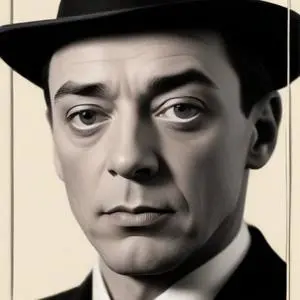
A pioneering silent film comedian, known for his deadpan expression and ingenious physical comedy, who wrote, directed, and starred in his own films.
Buster Keaton, also known as "The Great Stone Face," is renowned for his ingenious physical comedy and groundbreaking stunts in the silent film era of the 1920s. His deadpan expression, which earned him his iconic nickname, has become an unmistakable hallmark of his remarkable career.
Born Joseph Frank Keaton on October 4, 1895, Buster began his life in the entertainment industry as a child vaudeville star, performing with his family's traveling act. This early exposure to the world of comedy and performance laid the foundation for his future success.
As an adult, Keaton collaborated with independent producer Joseph M. Schenck and filmmaker Edward F. Cline, resulting in a string of successful two-reel comedies in the early 1920s. Some of his notable works from this period include One Week (1920), The Playhouse (1921), Cops (1922), and The Electric House (1922).
Keaton's transition to feature-length films cemented his status as a comedic genius. His most celebrated works, such as Sherlock Jr. (1924), The General (1926), Steamboat Bill, Jr. (1928), and The Cameraman (1928), continue to be revered by audiences and critics alike. Orson Welles, a renowned filmmaker, praised The General as "perhaps the greatest comedy ever made... and perhaps the greatest film ever made."
After signing with Metro-Goldwyn-Mayer (MGM) in 1928, Keaton's career suffered a decline, as he lost his artistic independence. His personal life also faced turmoil, including a divorce from his first wife and struggles with alcoholism. However, with the support of his second wife, Eleanor Norris, Keaton's career experienced a resurgence in the 1940s, and he continued to work as a respected comic performer until the end of his life.
In the later years of his life, Keaton made memorable cameos in films such as Sunset Boulevard (1950) and Limelight (1952), in addition to appearances on various television programs. He received an Academy Honorary Award in 1959, recognizing his contributions to the film industry. Critic Roger Ebert praised Keaton's remarkable period of creative output from 1920 to 1929, stating that it made him "the greatest actor-director in the history of the movies."
Buster Keaton's innovative approach to physical comedy and his pioneering work in the silent film era continue to inspire generations of comedians, filmmakers, and actors. His legacy extends beyond the realm of entertainment, as his unique brand of humor and resilience in the face of adversity have made a lasting impact on popular culture.
Born in 1889
A pioneer of silent film, he is renowned for his iconic "Little Tramp" character and groundbreaking work in writing, directing, and starring in his own movies.
Born in 1893
Pioneering silent film star and stunt master, known for performing daring physical comedy and iconic scenes, such as hanging from a clock tower.
Born in 1905
A legendary actress who captivated audiences with her iconic performances on the silver screen, earning her the title of Hollywood's first female superstar.
Born in 1893
Pioneering silent film star and director, known for her iconic performances in classics like "The Birth of a Nation" and "Broken Blossoms".
Born in 1898
Silent film star and director who charmed audiences with her expressive face and comedic timing, starring in over 100 films from 1912 to 1963.
Born in 1892
A pioneering actress, producer, and screenwriter who co-founded United Artists, revolutionizing the film industry with her creative vision and business acumen. She was a silent film star and one of the most popular actresses of her time.
Born in 1883
A swashbuckling pioneer of silent films, known for his daring stunts and charming on-screen presence, revolutionizing the action-adventure genre.
