


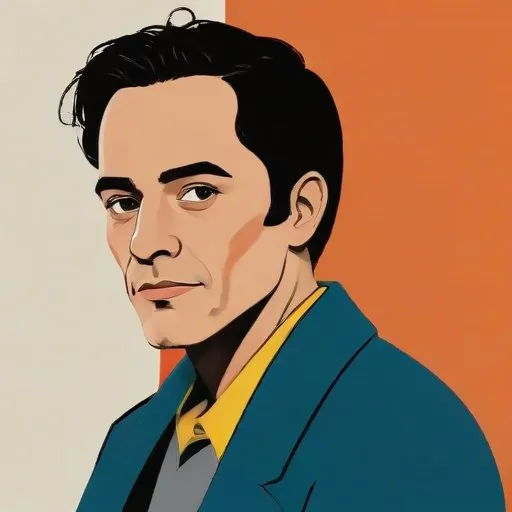
A prominent Brazilian writer, known for his poetic and provocative works that explored themes of love, desire, and social critique, particularly in the context of Brazil's military dictatorship.
Caio Fernando Abreu, one of the most influential and original Brazilian writers of the 1970s and 1980s, left an indelible mark on the nation's literary landscape with his poignant and provocative chronicles. Through his writing, Abreu captured the essence of Brazil's tumultuous era, weaving a tapestry of stories that continue to resonate with readers today.
Born on September 12, 1948, in Santiago do Boqueiro, Rio Grande do Sul, Abreu's early life was marked by a restless curiosity and a passion for words. He studied at the Universidade Federal do Rio Grande do Sul but abandoned academia to pursue a career in writing, contributing to popular culture magazines such as Revista Nova, Revista Manchete, and Revista Veja.
In 1968, Abreu's writing attracted the attention of the DOPS (Departamento de Ordem Política e Social), a repressive branch of the Brazilian government, and he was forced to go into hiding at the country estate of writer Hilda Hilst. This period of exile would later influence his writing, infusing his work with a sense of rebellion and social commentary.
Abreu's writing defied genre categorization, spanning short stories, novels, chronicles, and drama. His work often explored the liminal spaces of Brazilian society, capturing the complexities of human experience with unflinching honesty. Through his writing, Abreu gave voice to the marginalized, challenging societal norms and pushing the boundaries of what was considered acceptable.
His prolific output earned him recognition as a leading literary figure of his generation, and his writing continues to inspire new generations of Brazilian writers.
In the early 1970s, Abreu embarked on a year-long journey through Europe, spending time in England, Sweden, France, the Netherlands, and Spain. This period of self-exile allowed him to distill his thoughts, experiences, and observations into a unique literary voice that blended European influences with Brazilian sensibilities.
Upon his return to Brazil, Abreu continued to explore new horizons, relocating from Porto Alegre to Rio de Janeiro and later to São Paulo. His wanderlust eventually led him to France, where he discovered he was HIV positive in 1994. Abreu returned to Porto Alegre to live with his parents, devoting himself to gardening and writing until his untimely passing on February 25, 1996.
Caio Fernando Abreu's literature is a testament to the cultural, social, and political landscape of Brazil in the 1970s and 1980s. His writing continues to inspire, provoke, and challenge readers today, offering a unique glimpse into a tumultuous era.
Through his work, Abreu forged a new path for Brazilian literature, one that blended the personal with the political, the intimate with the universal. His legacy serves as a beacon for writers, artists, and thinkers, inspiring them to explore the complexities of human experience with courage, creativity, and unyielding passion.
Born in 1920
A Ukrainian-Brazilian journalist and author who explored the human condition through lyrical, introspective fiction, often focusing on the inner lives of women. Her writing is celebrated for its poetic, philosophical, and psychological depth.
Born in 1902
A Portuguese journalist who covered several international conflicts, including the Portuguese Colonial War and the Carnation Revolution, providing firsthand reports from the front lines.
Born in 1912
A celebrated writer of novels and poetry that vividly capture the spirit of Brazil's people and culture, exploring themes of love, social justice, and identity. His works are considered some of the most important in Brazilian literature.
Born in 1913
A renowned poet, playwright, and composer who merged Brazilian rhythms with French existentialism, creating iconic bossa nova songs like "The Girl from Ipanema".
Born in 1902
A leading figure in Brazilian modernism, known for his introspective and lyrically rich poetry that explores themes of love, nature, and the human condition.
