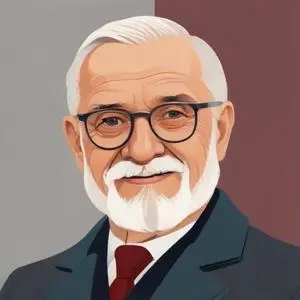
Carl Gustav Hempel

Carl Gustav Hempel

Carl Gustav Hempel was born on January 8th, 1905

Full Name: Carl Gustav Hempel
Born: January 8, 1905
Died: November 9, 1997
Nationality: German-American
Occupation: Philosopher
Notable Works: Aspects of Scientific Explanation
Education: University of Göttingen
Awards: Kyoto Prize

A key figure in the development of logical positivism, they sought to establish a scientific philosophy that emphasized empirical evidence and logical reasoning. Their work significantly influenced the philosophy of science and epistemology.

Written by: Thomas Blackwood Thomas Blackwood

Carl Gustav Hempel: The Architect of Logical Empiricism

Carl Gustav Hempel, a titan in the realm of philosophy, is renowned for his groundbreaking contributions to the field of logical empiricism. His articulation of the deductive-nomological model of scientific explanation, coupled with the infamous raven paradox, has left an indelible mark on the philosophy of science.

Early Life and Education

Hempel was born on January 8, 1905, in Oranienburg, Germany. He embarked on his academic journey at the University of Göttingen, where he delved into mathematics, physics, and philosophy. Subsequently, he moved to the University of Berlin and Heidelberg University, where he came under the influence of prominent thinkers such as David Hilbert and Rudolf Carnap.

The Berlin Circle and the Vienna Circle

In 1929, Hempel participated in a congress on scientific philosophy in Berlin, where he became acquainted with the Berlin Circle of philosophers associated with the Vienna Circle. This encounter had a profound impact on his intellectual trajectory, shaping his thoughts on logical empiricism.

The Doctoral Degree and Early Career

In 1934, Hempel received his doctoral degree from the University of Berlin with a dissertation on probability theory, titled "Beiträge zur logischen Analyse des Wahrscheinlichkeitsbegriffs" (Contributions to the Logical Analysis of the Concept of Probability). Hans Reichenbach, Wolfgang Köhler, and Nicolai Hartmann served as his doctoral supervisors.

Within a year of completing his doctorate, the rising tide of Nazism in Germany prompted Hempel to emigrate to Belgium due to his wife's Jewish ancestry. In 1936, he co-authored the book "Der Typusbegriff im Lichte der neuen Logik" (The Concept of Type in the Light of New Logic) with Paul Oppenheim, a scientist who aided his emigration.

The American Odyssey

In 1937, Hempel emigrated to the United States, where he accepted a position as Carnap's assistant at the University of Chicago. This marked the beginning of a new chapter in his life, during which he would make significant contributions to the development of logical empiricism.

The Raven Paradox and the Deductive-Nomological Model

Hempel's most notable contribution to philosophy is perhaps the raven paradox, also known as Hempel's paradox. This thought-provoking problem highlights the limitations of inductive reasoning and has been the subject of much debate and discussion. Furthermore, his articulation of the deductive-nomological model of scientific explanation has been widely regarded as the standard model of scientific explanation during the 1950s and 1960s.

Legacy and Impact

Hempel's work has had a profound impact on the development of philosophy, particularly in the areas of logical empiricism, philosophy of science, and epistemology. His contributions have influenced generations of philosophers, including prominent thinkers such as Karl Popper and Imre Lakatos.

Carl Gustav Hempel's intellectual legacy continues to inspire and challenge philosophers, scientists, and thinkers to this day, cementing his place as one of the most important figures in 20th-century philosophy.

Timeline
1905
Born in Oranienburg
Carl Gustav Hempel was born on January 8, 1905, in Oranienburg, German Empire.
1929
Received PhD in Physics
Hempel received his PhD in physics from the University of Göttingen, where he later became a professor.
1935
Fled to Denmark
Hempel fled to Denmark to escape the Nazi regime, later emigrating to the United States.
1950
Published Problems and Changes in the Empiricist Criterion of Meaning
Hempel published his influential paper Problems and Changes in the Empiricist Criterion of Meaning, which explored the foundations of scientific knowledge.
1997
Died in Princeton
Carl Gustav Hempel died on November 9, 1997, in Princeton, New Jersey, leaving behind a legacy as a prominent philosopher of science.
Carl Gustav Hempel

Carl Gustav Hempel Quiz

What philosophical movement was Carl Gustav Hempel a key figure in?

Score: 0/5
FAQ
What is Carl Gustav Hempels most famous philosophical contribution?
Carl Gustav Hempels most famous philosophical contribution is his work on the philosophy of science, particularly his development of the concept of covering law theory. This theory posits that scientific explanations involve the subsumption of particular events under general laws, and that these laws provide the underlying mechanism for explaining natural phenomena.
How did Carl Gustav Hempels work influence the development of logical positivism?
Carl Gustav Hempels work was instrumental in shaping the development of logical positivism, a philosophical movement that emphasized the importance of empirical evidence and logical analysis in understanding scientific knowledge. Hempels ideas about the nature of scientific explanation and the role of laws in scientific inquiry were central to the development of logical positivism.
What is Carl Gustav Hempels view on the nature of scientific laws?
Carl Gustav Hempel believed that scientific laws are universal statements that describe the relationships between phenomena in the natural world. He argued that laws are not simply summaries of observed phenomena, but rather provide a underlying structure for understanding and explaining natural events.
Did Carl Gustav Hempel have a significant impact on the philosophy of history?
Yes, Carl Gustav Hempel had a significant impact on the philosophy of history. His work on the nature of historical explanation and the role of laws in understanding historical events helped to shape the development of the philosophy of history.
What is Carl Gustav Hempels legacy in modern philosophy?
Carl Gustav Hempels legacy in modern philosophy is significant. His work on the philosophy of science, philosophy of history, and logical positivism has influenced generations of philosophers and continues to shape debates about the nature of knowledge, explanation, and understanding.