


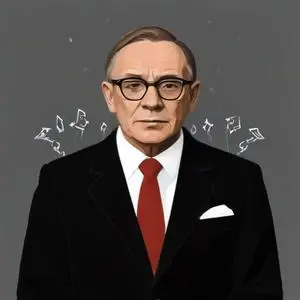
A renowned composer and educator, he's famous for his iconic cantata "Carmina Burana", which has become a cultural phenomenon, and his innovative approach to music education.
German composer and music educator Carl Orff is best known for his iconic cantata Carmina Burana, a work that has captivated audiences for generations with its mesmerizing blend of medieval poetry and modern musicality. Orff's innovative approach to music education, as embodied in his Schulwerk concept, has also had a profound impact on children's music education.
Born on July 10, 1895, in Munich, Germany, Orff was surrounded by music from an early age. His father, Heinrich Orff, was an army officer with a strong passion for music, while his mother, Paula Orff (née Köstler), was a trained pianist. This musical upbringing was complemented by his family's rich cultural heritage, with both grandfathers being major generals and scholars.
Orff's musical journey began at the age of five, when he started playing the piano. He later studied cello and organ, and by his early teens, he was composing his own music, including songs and scores for puppet plays. In 1905, at just 10 years old, two of his vignettes were published in the children's supplement to Die katholische Familie.
Orff's formative years were marked by exposure to some of the most significant musical events of the time. He attended concerts featuring renowned composers such as Gustav Mahler and Richard Strauss, and in 1911, he witnessed the world premiere of Mahler's Das Lied von der Erde. These experiences would later influence his own compositional style.
In 1937, Orff composed Carmina Burana, a work that would catapult him to international fame. Based on medieval poetry, the cantata's unique blend of choral and orchestral elements has made it a beloved classic, with its haunting melodies and rhythmic energy continuing to captivate audiences today.
Orff's Schulwerk philosophy, developed in the 1920s and 1930s, emphasized the importance of music education for children. He believed that music should be accessible to all, regardless of social class or background, and that it had the power to bring people together and foster a sense of community.
Orff's legacy extends far beyond Carmina Burana. His innovative approach to music education has inspired generations of music teachers and educators, and his compositions continue to be performed and admired around the world. Today, the Carl Orff Institute in Munich remains a testament to his enduring influence on the world of music.
Carl Orff's remarkable life and legacy serve as a testament to the power of music to inspire, educate, and bring people together.
Born in 1864
A renowned composer and conductor of the late Romantic era, known for his tone poems and operas that showcased his mastery of orchestration and expressive storytelling.
Born in 1860
A visionary composer and conductor who expanded symphonic music's emotional depth and complexity, creating works of profound beauty and intensity.
Born in 1883
A pioneering figure in atonality and twelve-tone technique, revolutionizing classical music with concise, expressive works that explored new sounds and structures.
Born in 1874
A pioneer of atonality and 12-tone serialism, revolutionizing classical music with innovative compositions that pushed boundaries of harmony and melody.
Born in 1882
A Russian master of music, renowned for revolutionizing classical music with bold, avant-garde compositions that blended traditional and modern elements. His iconic works, such as "The Rite of Spring," continue to inspire and influence artists across genres.
Born in 1881
A Hungarian musical genius who merged folk melodies with modernist techniques, creating a unique sound that transformed classical music.
Born in 1882
A Hungarian composer, conductor, and musicologist who developed a unique style blending folk and classical music, and is renowned for his contributions to music education and ethnomusicology.
Born in 1892
A French composer and educator who blended jazz and classical music to create a unique sound, and is best known for his ballet scores and chamber music compositions.
