


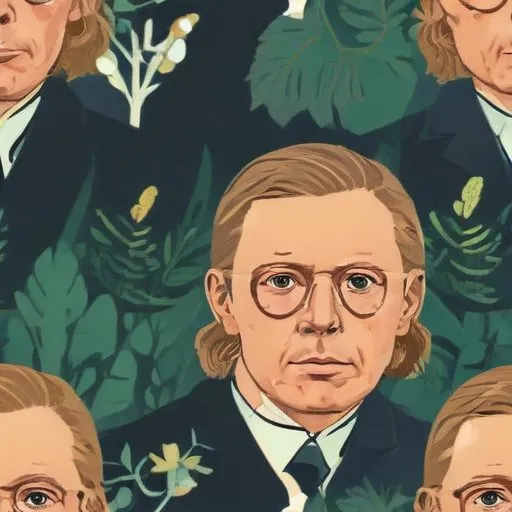
A Swedish scientist who made significant contributions to the fields of botany, entomology, and psychology, particularly in the discovery of new plant and insect species. He's also known as the "father of South African botany" for his extensive research on the region's flora.
Carl Peter Thunberg, a Swedish naturalist, is renowned for his groundbreaking contributions to the field of botany, particularly in South Africa and Japan. Dubbed the "father of South African botany" and the "Japanese Linnaeus," Thunberg's tireless efforts in documenting and classifying plant and animal species have left an indelible mark on the scientific community.
Born on November 11, 1743, in Jönköping, Sweden, Thunberg grew up with an insatiable curiosity for the natural world. He pursued higher education at Uppsala University, where he came under the tutelage of the acclaimed Carl Linnaeus, widely regarded as the father of modern taxonomy. Thunberg's six-year stint at the university (1761-1767) laid the foundation for his future expeditions and research endeavors.
In 1770, Thunberg embarked on a seven-year journey to southern Italy and Asia, which would prove pivotal in his career. During this period, he traveled to Paris and Amsterdam, where he met notable botanists and physicians, including Johannes Burman and Nicolaas Burman. The elder Burman, impressed by Thunberg's inquisitive nature and expertise in botany and medicine, encouraged him to explore the East or West Indies to collect specimens for the Leiden botanic garden.
In December 1771, Thunberg set sail for the Cape of Good Hope as a surgeon on board the Schoonzicht, a Dutch East India Company vessel. Over the next three years, he spent his days observing and documenting the region's flora and fauna. This period saw the collection of numerous plant and animal specimens, many of which were new to European science. Thunberg's meticulous recordings and descriptions of the local cultures and customs also provide valuable insights into the region's history.
In 1775, Thunberg arrived in Japan, where he spent the next two years studying the local flora, fauna, and medical practices. His contributions to the field of medicine in Japan were instrumental in introducing Western medical practices to the country. Thunberg's experiences in Japan are chronicled in his book, "Travels in Europe, Africa, and Asia," which provides a fascinating account of his encounters with the Japanese people and their customs.
Thunberg's scientific contributions have had a lasting impact on our understanding of the natural world. He described over 3,000 plant species, many of which bear his name. His work in South Africa and Japan paved the way for future generations of naturalists and scientists. Today, Thunberg is celebrated as a pioneer in the fields of botany, medicine, and anthropology.
Thunberg's remarkable life and achievements serve as a testament to his unwavering passion for discovery and his dedication to advancing our understanding of the natural world.
Born in 1748
A Swedish physician and activist who traveled with Captain James Cook on his second voyage, documenting indigenous cultures and advocating for abolition of slavery.
Born in 1716
A Swedish-Finnish botanist and explorer who traveled to North America in the 1740s to study its natural history, documenting new species and providing valuable insights into the region's flora and fauna.
