


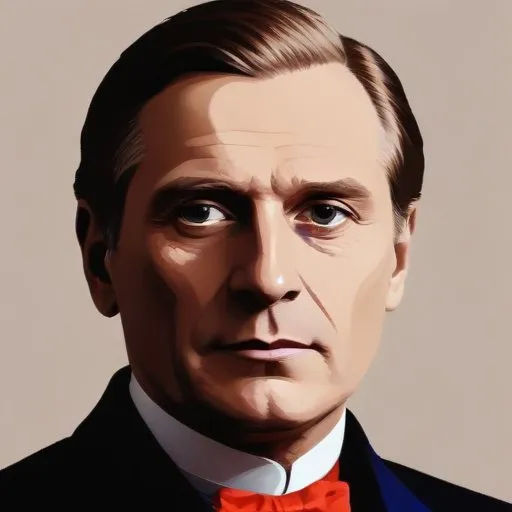
Governor of Liechtenstein from 1897 to 1913, known for modernizing the country's infrastructure and economy. He played a key role in Liechtenstein's transition from an agrarian to an industrial society.
Carl von In der Maur was an Austrian aristocrat and statesman who left an indelible mark on the governance of Liechtenstein, serving as its Governor twice between 1884 and 1913. Known for his domineering style of governance, von In der Maur reformed the administration, expanding regulations and government responsibilities, often to the chagrin of the Landtag.
Born on October 16, 1852, in Wiener Neustadt, Austrian Empire, von In der Maur hailed from the Tyrolese noble family of In der Maur. His father, Karl Johann Josef Romed von In der Maur auf Strelburg und zu Freifeld, was a high-ranking official in the Austrian government, serving as the Assistant Secretary of the Ministry of Education. Von In der Maur attended secondary school in Vienna before studying law and political science at the Theresian Military Academy, where he graduated with honors in 1875.
After completing his education, von In der Maur joined the Lower Austrian State Service. His impressive credentials and family connections paved the way for his appointment as Governor of Liechtenstein in 1884, a position he held until 1892. During his initial tenure, von In der Maur introduced sweeping reforms, expanding the government's responsibilities and regulatory powers.
Von In der Maur's authoritarian style of governance often put him at odds with the Landtag, the Liechtenstein parliament. He was known to disregard their wishes, sparking controversy and criticism. Despite this, von In der Maur maintained his connections with the government, serving as a Frstlicher Kabinettsrat in Vienna from 1892 to 1897.
In 1897, von In der Maur returned to Liechtenstein as Governor, serving in a provisional capacity until his death in 1913. His second tenure was marked by continued reforms and expansion of government powers, solidifying his legacy as a shaper of Liechtenstein's governance. Von In der Maur's life was cut short in 1913, when he suffered a stroke during an impassioned debate in the Landtag.
Von In der Maur's governance style was characterized by a strong central authority and an emphasis on bureaucratic efficiency. While his approach was often criticized for being authoritarian, it reflect a particular philosophical bent, prioritizing stability and order over individual liberties.
Von In der Maur's legacy extends beyond his tenure in Liechtenstein. His reforms and governance style have influenced the development of administrative structures in other small European states. His emphasis on bureaucratic efficiency and central authority continues to shape policy discussions in modern Liechtenstein.
81 Years Old
The reigning monarch of the Principality of Liechtenstein, known for his progressive policies and efforts to modernize the country while maintaining its independence and neutrality. He is also a successful businessman and banker.
Born in 1912
The last Crown Prince of Austria-Hungary was the heir to the throne of the former Austro-Hungarian Empire, and is known for his efforts to promote European unity and cooperation. He was a prominent politician and writer who played a key role in shaping European politics after World War II.
65 Years Old
The current head of the former ruling dynasty of Austria-Hungary, he is a politician and advocate for European unity and human rights, known for his efforts to promote democracy and reconciliation.
