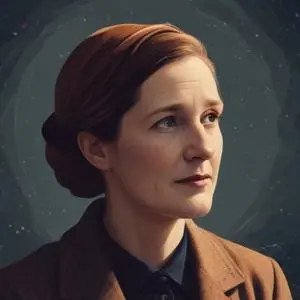
Cecilia Payne-Gaposchkin: The Astronomer Who Revolutionized Our Understanding of the Universe
The Pioneering Astronomer Who Changed the Face of Astrophysics
Cecilia Payne-Gaposchkin, a British-born American astronomer, is best known for her groundbreaking proposal that stars are composed primarily of hydrogen and helium, a conclusion that challenged the conventional wisdom of her time. Her pioneering work in the field of astrophysics paved the way for a deeper understanding of the universe, earning her a revered place in the annals of scientific history.
Early Life and Education
Born on May 10, 1900, in Wendover, Buckinghamshire, England, Cecilia Helena Payne was one of three children to Emma Leonora Helena (née Pertz) and Edward
John Payne, a London barrister, historian, and musician. Her mother, from a Prussian family, had two distinguished uncles, including the historian
Georg Heinrich Pertz and the Swedenborgian writer James John Garth Wilkinson. After her father's untimely death when she was just four years old, her mother single-handedly raised the family.
Cecilia's education began at a private school in Wendover, run by Elizabeth Edwards. At the age of twelve, her mother moved to London to ensure her brother Humfry received a good education, later becoming an archaeologist. Cecilia then attended St. Mary's College, Paddington, where she was unable to study mathematics or science. She later transferred to St. Paul's Girls School, where
Gustav Holst, a music teacher, encouraged her to pursue a career in music. However, Cecilia's passion lay in science, and she won a scholarship to Newnham College, Cambridge University, where she initially read botany, physics, and chemistry.
The Birth of a New Era in Astrophysics
Payne-Gaposchkin's interest in astronomy was sparked by a lecture by
Arthur Eddington, a renowned astrophysicist. At Cambridge, she met
Meghnad Saha, an Indian astrophysicist, who had developed the theory of thermal ionization. Her work with Saha greatly influenced her research, which led to her groundbreaking 1925 doctoral thesis. In this seminal work, Payne-Gaposchkin proposed that stars were primarily composed of hydrogen and helium, contradicting the prevailing scientific wisdom of the time.
-initially, her conclusions were met with skepticism, but subsequent observations and research vindicated her theory. Her work laid the foundation for modern astrophysics, transforming our understanding of the universe.
Career Highlights and Major Works
Throughout her illustrious career, Payne-Gaposchkin made significant contributions to the field of astrophysics. Her notable works include:
- Stellar Atmospheres (1930), a comprehensive study on the atmospheres of stars
- The Stars of High Luminosity (1931), a detailed examination of the brightest stars in the universe
-
Awards and Honors
Payne-Gaposchkin's pioneering work earned her numerous accolades, including:
- 1919: Scholarship to Newnham College, Cambridge University
- 1926: Fellowship at Radcliffe College, Harvard University
- 1943: Annie Jump Cannon Award for outstanding contributions to astronomy
- 1961: Henry Norris Russell Lectureship, American Astronomical Society
Personal Milestones and Key Life Events
In 1931, Payne-Gaposchkin married Russian-born astrophysicist Sergei Gaposchkin, with whom she had three children. The couple moved to the United States, where Payne-Gaposchkin became a naturalized citizen in 1934. She continued to work at Harvard University, where she was eventually appointed as a full professor in 1956.
Legacy and Impact
Cecilia Payne-Gaposchkin's trailblazing work in astrophysics paved the way for future generations of scientists. Her groundbreaking research revolutionized our understanding of the universe, earning her a place among the most influential astronomers of the 20th century. Today, her legacy continues to inspire scientists, students, and enthusiasts alike, fostering a deeper appreciation for the wonders of the cosmos.
Inspirational Quotes
"The universe is not only stranger than we think, it is stranger than we can think."
- Cecilia Payne-Gaposchkin