


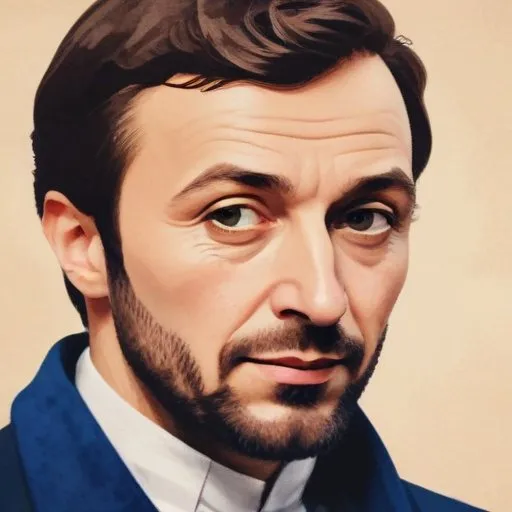
A 17th-century philosopher and writer who challenged Aristotelian views and developed a rational approach to understanding the natural world, influencing the scientific revolution.
Cesare Cremonini, a 16th-century Italian philosopher, is famously known for his remarkable contributions to the field of natural philosophy, earning him patronage from Alfonso II d'Este, Duke of Ferrara, and recognition from kings and princes across Europe. His impressive 60-year tenure as a professor of natural philosophy at the Universities of Ferrara and Padua solidified his reputation as one of the greatest philosophers of his time.
Born on December 22, 1550, in Cento, Papal States (now Italy), Cremonini demonstrated exceptional talent from a young age. His remarkable intellect caught the attention of Alfonso II d'Este, who provided him with patronage, enabling him to pursue his academic endeavors.
Cremonini's academic career spanned six decades, during which he taught the doctrines of Aristotle, particularly as interpreted by Alexander of Aphrodisias and Averroes. He held chairs of natural philosophy and medicine at the Universities of Ferrara and Padua, respectively. His teachings were highly regarded, and he was consulted by kings and princes on private and public matters.
Cremonini's reputation was somewhat tarnished by his infamous refusal to look through Galileo Galilei's telescope, alongside another scholar. This incident has overshadowed his remarkable achievements, relegating him to a mere footnote in the annals of history.
Despite the Galileo affair, Cremonini's impact on modern society and philosophy remains significant. He influenced many French intellectuals, who referred to him as "le grand Cremonin." His teachings and writings continue to shape the field of natural philosophy, ensuring his legacy as a prominent philosopher of his time.
Cremonini's personal life was marked by his dedication to his academic pursuits. He was known for his popularity among the French intellectuals, who corresponded with him and sought his counsel on various matters.
Unfortunately, there are no recorded quotes or memorable sayings attributed to Cesare Cremonini. However, his teachings and writings continue to inspire and educate scholars to this day.
Cremonini's life and work were set against the backdrop of the Renaissance and the Scientific Revolution. His philosophical contributions, although somewhat overshadowed by the Galileo affair, remain an essential part of the historical narrative of 16th-century European philosophy.
In comparison to his contemporaries, Cremonini's philosophical views were distinct, leaning towards rationalism and Aristotelian materialism. His academic career, although marked by controversy, was characterized by his unwavering commitment to his teachings and his patrons.
Born in 1463
Renaissance humanist and philosopher who wrote the famous "Oration on the Dignity of Man," a treatise that declared human beings' potential for greatness and their capacity for self-improvement. He's known for his emphasis on humanism and individualism.
Born in 1433
An Italian Renaissance philosopher who translated Plato's works into Latin, reviving classical Greek philosophy and influencing the development of Western esotericism. He's also known for his astrological writings and their impact on Renaissance thought.
Born in 1462
An Italian Renaissance philosopher who challenged the dominant Aristotelian views, arguing that the soul is mortal and that morality is based on human nature rather than divine law.
Born in 1463
A 16th-century Italian physician and philosopher who wrote extensively on topics like medicine, philosophy, and astronomy, making significant contributions to the Renaissance humanist movement.
Born in 1477
A 16th-century Catholic reformer and diplomat who played a key role in the Council of Trent, advocating for Church renewal and dialogue with Protestants.
Born in 1466
Renowned for inventing the first movable-type printing press for music, revolutionizing music publishing and making it more accessible. This innovation enabled mass production of sheet music, democratizing music education and performance.
Born in 1404
Renaissance mastermind who excelled in various artistic and intellectual pursuits, leaving a lasting impact on the development of humanism and art theory.
