


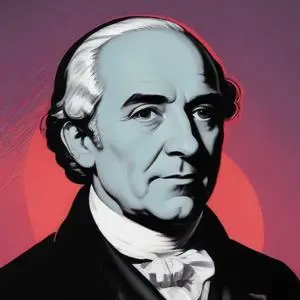
Developed the theory of electrostatic attraction and repulsion, and invented the torsion balance to measure electric charges.
Charles-Augustin de Coulomb is best known for his groundbreaking work in physics, particularly his discovery of the electrostatic force of attraction and repulsion, now famously known as Coulomb's Law. This fundamental concept has far-reaching implications in the world of physics, engineering, and beyond, earning Coulomb a revered place in the annals of scientific history.
Born on June 14, 1736, in Angoulême, Angoumois county, France, Coulomb was the son of Henry Coulomb, an inspector of the royal demesne, and Catherine Bajet. His family moved to Paris early in his childhood, where he received a comprehensive education at Collège Mazarin, studying philosophy, language, literature, mathematics, astronomy, chemistry, and botany.
After his father's financial setbacks, Coulomb was forced to leave Paris and join the French army as an engineer with the rank of lieutenant. Over the next twenty years, he was posted to various locations, working on engineering projects, including structural, fortifications, and soil mechanics. His notable postings include Brest, Martinique, and Bouchain, where he built the new Fort Bourbon and gained valuable experience that would shape his future works.
During his time in Martinique, Coulomb began to develop his ideas on electrostatic force, eventually leading to the publication of his seminal work, "Recherches théoriques et expérimentales sur la loi de l'action mutuelle de deux pôles magnétiques et sur les lois de l'action mutuelle de deux charges électriques" (Theoretical and Experimental Research on the Law of the Mutual Action of Two Magnetic Poles and on the Laws of the Mutual Action of Two Electric Charges) in 1785. This work laid the foundation for Coulomb's Law, which describes the electrostatic force of attraction and repulsion between two charged objects.
In recognition of his monumental contribution to physics, the SI unit of electric charge, the coulomb, was named in his honor in 1880. Coulomb's work has had a profound impact on the development of electrical engineering, electromagnetism, and physics as a whole. His legacy continues to inspire generations of scientists and engineers, solidifying his place as one of the most influential physicists of all time.
Coulomb's health suffered greatly during his time in Martinique, where he contracted diseases that would affect him for the rest of his life. Despite these challenges, he remained committed to his work, continuing to publish important papers until his death on August 23, 1806.
Coulomb's work was not only groundbreaking in its scientific implications but also reflected his philosophical perspective. He believed in the importance of experimentation and empirical evidence, emphasizing the need for rigorous testing and validation of hypotheses. This approach has had a lasting impact on the scientific community, shaping the way we conduct research and evaluate theories.
Coulomb's Law has far-reaching implications in various fields, including electrical engineering, electromagnetism, and materials science. His work has enabled the development of countless technologies, from household appliances to medical devices, and continues to influence innovation in the modern era.
Charles-Augustin de Coulomb's remarkable life and work leave a lasting legacy in the world of physics, a testament to the power of human curiosity and innovation.
Born in 1775
A pioneer in the field of electromagnetism, he formulated fundamental laws that describe the relationship between electric currents and magnetic fields. His work laid the foundation for many modern technologies, including electric motors and generators.
Born in 1854
A pioneer in mathematics and physics, he laid the foundations for modern chaos theory, topology, and relativity, making groundbreaking contributions to our understanding of space and time.
Born in 1749
Developed nebular hypothesis of the origin of the solar system and formulated Laplace's equation, a fundamental concept in mathematics and physics. He's considered the founder of celestial mechanics.
Born in 1623
A 17th-century genius who made major contributions to mathematics, physics, and philosophy, inventing the mechanical calculator and developing the theory of probability. His writings also explored the human condition and faith.
Born in 1596
Developed influential philosophical and mathematical concepts, including the famous phrase "I think, therefore I am," and laid the foundation for modern Western philosophy.
Born in 1707
Pioneering mathematician and physicist who made immense contributions to fields like calculus, number theory, and optics, shaping the course of modern mathematics and physics.
Born in 1736
Developed calculus, number theory, and celestial mechanics, making significant contributions to the fields of mathematics and astronomy.
Born in 1774
A French polymath who made significant contributions to the fields of physics, astronomy, and mathematics, particularly in the discovery of chromatic polarization and the Biot-Savart law.
