


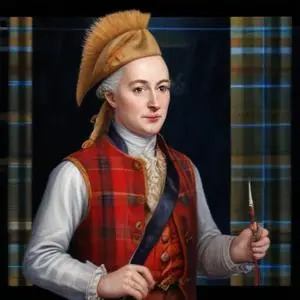
Leader of the Jacobite rising of 1745, attempting to restore the Stuart dynasty to the British throne, and famously defeated at the Battle of Culloden. Romanticized as "Bonnie Prince Charlie" in Scottish folklore.
Charles Edward Stuart, infamously known as Bonnie Prince Charlie, was the Scottish prince who led the ill-fated Jacobite rising of 1745, attempting to restore the Stuart monarchy to the British throne. His audacious endeavors, although ultimately unsuccessful, have cemented his place in history as a romantic figure of heroic proportions.
Born on December 31, 1720, in Rome, Charles was the grandson of James VII and II, and the son of James Francis Edward Stuart, the Old Pretender. His early life was spent in Italy, surrounded by the exiled Stuart court. However, Charles's destiny lay elsewhere, and in 1744, he traveled to France to participate in a planned invasion to restore the Stuart monarchy under his father.
With the Jacobite cause lost, Charles spent the remainder of his life on the continent, except for one secret visit to London. He lived briefly in France before being exiled in 1748 under the terms of the Treaty of Aix-la-Chapelle. Charles eventually returned to Italy, where he spent much of his later life living in Florence and Rome.
Charles had a number of mistresses before marrying Princess Louise of Stolberg-Gedern in 1772. However, his later life was marked by declining health and allegations of alcoholism. Despite this, his escapades during the 1745 and 1746 uprising, as well as his escape from Scotland, have contributed to his enduring romantic image.
Charles Edward Stuart's story has inspired numerous works of literature, art, and film, cementing his place in popular culture. His legacy as a symbol of Scottish nationalism and his tragic love story with Flora MacDonald have ensured his continued fascination for generations to come.
In the end, Charles Edward Stuart's life was a testament to the power of ambition, romance, and the human spirit. Although his dreams of restoring the Stuart monarchy were ultimately thwarted, his bravery and determination have secured his place in history as one of the most captivating figures of the 18th century.
Born in 1926
A pioneering female banker and politician who broke glass ceilings in Canada's financial and political spheres, remembered for her trailblazing achievements in a male-dominated era.
Born in 1688
The last serious Jacobite pretender to the British throne, known for leading a rebellion to restore the Stuart dynasty, which ended in defeat at the Battle of Culloden in 1746.
Born in 1710
The monarch who ruled France from 1715 to 1774, known as the "Sun King's" great-grandson, and remembered for his extravagance, absolutism, and the decline of the French monarchy.
Born in 1694
A Scottish Jacobite general who played a key role in the 1745 Jacobite Rising, leading Charles Edward Stuart's forces to several victories before being forced into exile. He's remembered for his bravery and tactical genius.
