


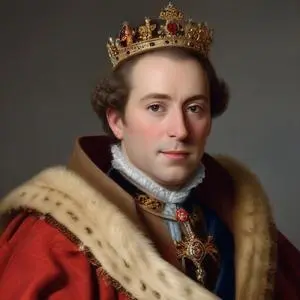
The last serious Jacobite pretender to the British throne, known for leading a rebellion to restore the Stuart dynasty, which ended in defeat at the Battle of Culloden in 1746.
James Francis Edward Stuart, also known as the Old Pretender, was the son of King James II and VII of England, Scotland, and Ireland, and his second wife, Mary of Modena. He is best known for his claim to the British throne, which he asserted from 1701 until his death in 1766, sparking a series of Jacobite risings in an attempt to restore the Stuart dynasty to power.
James Francis Edward Stuart was born on June 10, 1688, at St. James's Palace, London. As the eldest surviving son of the reigning monarch, he was automatically Duke of Cornwall and Duke of Rothesay at birth, and was created Prince of Wales in July 1688.
After the Glorious Revolution of 1688, James's Catholic father was deposed and exiled, and the Bill of Rights (1689) and Act of Settlement (1701) excluded Catholics from the English and British thrones. James was raised in Continental Europe, known as the Chevalier de St. George, and gained the support of his Jacobite followers and Louis XIV of France, a cousin of his father.
In 1701, following his father's death, James claimed the English, Scottish, and Irish crowns as James III of England and Ireland and James VIII of Scotland. He led two failed Jacobite risings, in 1715 and 1745, in an attempt to regain the British and Irish thrones.
Following James's death in 1766, his elder son Charles Edward Stuart, also known as the Young Pretender, continued to claim the British and Irish crowns as part of the Jacobite succession. Despite his failed attempts to restore the Stuart dynasty, James Francis Edward Stuart's legacy remains an important part of British history.
James Francis Edward Stuart's legacy extends beyond his claim to the throne. His attempts to restore the Stuart dynasty led to significant changes in British politics and society, shaping the course of history in the 18th century.
James Francis Edward Stuart's life and reign took place during a tumultuous period in British history, marked by political upheaval and religious strife. His claim to the throne represents a significant challenge to the established Protestant monarchy, and his legacy continues to fascinate historians and enthusiasts alike.
Born in 1720
Leader of the Jacobite rising of 1745, attempting to restore the Stuart dynasty to the British throne, and famously defeated at the Battle of Culloden. Romanticized as "Bonnie Prince Charlie" in Scottish folklore.
Born in 1633
The last Catholic monarch of England, Scotland, and Ireland, who attempted to restore Catholicism and absolute monarchy, sparking the Glorious Revolution. He's infamous for his authoritarian rule and religious intolerance.
Born in 1630
The last monarch of the House of Stuart, restored to the throne after a republican Commonwealth, known for his lavish spending, mistresses, and the Great Fire of London. He ruled with a mix of absolutism and indulgence, shaping England's Restoration era.
Born in 1683
King of Great Britain and Ireland from 1727 to 1760, known for his military victories, particularly the Battle of Dettingen, and his role in the War of the Austrian Succession.
Born in 1683
King of Great Britain and Ireland from 1727 to 1760, known for his military victories, particularly the Battle of Dettingen, and his role in the War of the Austrian Succession.
Born in 1738
The British monarch who ruled during the American Revolution, losing the colonies, and later suffered a mental illness that led to a regency crisis. He's also known for his cultural and artistic patronage.
Born in 1762
The extravagant and flamboyant King of the United Kingdom, known for his lavish lifestyle, extravagant fashion sense, and architectural projects, including the transformation of Buckingham Palace. He played a significant role in the development of Regency London.
Born in 1765
The third son of King George III, he unexpectedly inherited the throne and reigned from 1830 to 1837, notable for abolishing slavery in the British Empire.
