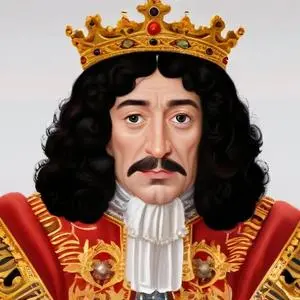
Charles II of England: The Merry Monarch
A King of Restoration and Revival
Charles II of England, also known as the Merry Monarch, is renowned for his pivotal role in restoring the monarchy after a period of republican governance and establishing a era of relative peace and cultural flourishing.
As the King of Scotland, England, and Ireland from 1649 to 1685, Charles II's reign was marked by his efforts to rebuild and strengthen the British monarchy, which had been severely damaged during the English Civil War.
Early Life and Exile
Born on May 29, 1630, to
Charles I of England, Scotland, and Ireland and
Henrietta Maria of France, Charles II was the eldest surviving child of the royal couple. After his father's execution in 1649, Charles was proclaimed king by the Parliament of Scotland, but he was forced to flee to mainland Europe after being defeated by
Oliver Cromwell at the Battle of Worcester in 1651.
The Restoration and Reign
Charles spent nine years in exile, during which he developed a strong sense of diplomacy and strategic alliances. After Cromwell's death in 1658, Charles was restored to the throne in 1660, marking the beginning of the Restoration period. His coronation on April 23, 1661, was a grand affair, with elaborate ceremonies and festivities that signaled a new era of monarchical power.
Domestic Policies and Achievements
During his reign, Charles II focused on rebuilding and consolidating the British monarchy. He:
- Established the Clarendon Code, a series of laws that strengthened the Church of England and ensured its dominance over other religious factions.
- Encouraged the arts, architecture, and literature, earning him the title of the "Merry Monarch."
- Fostered a culture of tolerance, issuing the Royal Declaration of Indulgence in 1672, which granted freedom of worship to Catholics and Protestant dissenters.
Foreign Policy and Alliances
Charles II's foreign policy was marked by his alliance with his cousin, King
Louis XIV of France. The Treaty of Dover in 1670 secured French support for Charles's military campaigns and provided him with a substantial pension. This alliance enabled Charles to:
- Wage the Second Anglo-Dutch War, which led to the capture of New York from the Dutch in 1664.
- Secure French support for his military campaigns in the Third Anglo-Dutch War.
Personal Life and Legacy
Charles II's personal life was marked by his numerous affairs and illegitimate children. He never married, but had many mistresses, including the notorious
Nell Gwyn. Despite his promiscuity, Charles II remained popular among his subjects, who affectionately called him the "Merry Monarch."
Charles II's legacy is complex and multifaceted. While he faced criticism for his perceived laziness and lack of strong leadership, he is also remembered for his role in restoring the monarchy and promoting a culture of tolerance and artistic expression.
Timelines and Milestones
- May 29, 1630: Born in St. James Palace, London
- 1649: Proclaimed king by the Parliament of Scotland
- 1651: Defeated by Oliver Cromwell at the Battle of Worcester
- 1658: Cromwell's death; begins planning his restoration
- 1660: Restored to the throne
- April 23, 1661: Coronation ceremony
- 1670: Signs the Treaty of Dover with King Louis XIV of France
- February 6, 1685: Dies of a stroke at Whitehall Palace
Overall, Charles II of England's reign marked a significant turning point in British history, as he navigated the complexities of monarchical power, foreign alliances, and domestic policies to establish a period of relative peace and cultural flourishing.
FAQ
What was Charles II of Englands role in the English Restoration?
Charles II of England was restored to the throne in 1660, following the English Civil War and the Interregnum, marking the beginning of the Restoration period.
What were Charles II of Englands relationships like with Parliament?
Charles II of England had a complex and often tumultuous relationship with Parliament, frequently clashing over issues of power, finance, and religion.
What was Charles II of Englands attitude towards religion?
Charles II of England was a Catholic sympathizer, but he pragmatically maintained the established Church of England to avoid conflict with Protestant factions.
What were Charles II of Englands cultural achievements?
Charles II of England was a patron of the arts, supporting prominent writers, artists, and architects, including John Wilmot, Earl of Rochester, and Christopher Wren.
What was Charles II of Englands legacy?
Charles II of Englands legacy is marked by his ability to restore stability and rebuild the English monarchy, despite facing numerous challenges and controversies during his reign.