


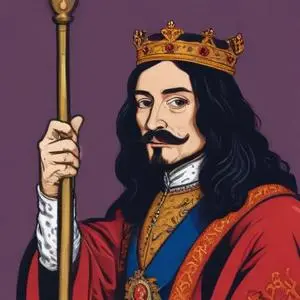
The monarch who ruled England, Scotland, and Ireland from 1625 to 1649, sparking the English Civil War and ultimately being executed for high treason. He's infamous for his absolutist views and clash with Parliament.
Charles I, the ill-fated monarch who ruled England, Scotland, and Ireland from 1625 to 1649, is best known for his tumultuous reign, marked by religious strife, parliamentary disputes, and ultimately, his own execution. His reign was a precarious balancing act between the monarchy's power and the growing influence of Parliament, which would eventually lead to his downfall.
Born on November 19, 1600, Charles was the second son of King James VI of Scotland and I of England, and his wife, Anne of Denmark. Following the death of his elder brother, Henry Frederick, Prince of Wales, in 1612, Charles became the heir apparent to the thrones of England, Scotland, and Ireland.
Charles's accession to the throne in 1625 was marked by controversy and turmoil. He clashed with Parliament over issues of taxation, religion, and royal prerogative, which would become recurring themes throughout his reign. The king's marriage to Henrietta Maria of France in 1625 further exacerbated tensions, as many of his subjects viewed her Catholicism with suspicion.
Charles's support for high church Anglican ecclesiastics and his failed attempts to aid continental Protestant forces during the Thirty Years' War led to widespread discontent. His policies, perceived as too Catholic, sparked opposition from Reformed religious groups, such as the English Puritans and Scottish Covenanters. The Bishops' Wars, which began in 1639, further destabilized the region and weakened the monarchy's authority.
The English Civil War, which began in 1642, pitted Charles's royalist forces against the armies of the English and Scottish parliaments. Despite initial successes, Charles was defeated in 1645 by the Parliamentarian New Model Army, led by Oliver Cromwell. After fleeing north from Oxford, Charles was eventually captured, tried, and executed on January 30, 1649, outside the Banqueting House in Whitehall.
Charles I's tumultuous reign and ultimate execution had far-reaching consequences for the monarchy, Parliament, and the English people. His demise marked the end of absolute monarchy in England and paved the way for the establishment of the Commonwealth of England under Oliver Cromwell. Charles's legacy continues to influence British history, serving as a cautionary tale about the dangers of unchecked power and the importance of constitutional monarchy.
"I have a great faith in the power of the English people to reform their own government."
"I will not do what I ought not, and I will do what I ought."
Charles I's reign was marked by significant historical events, including the Thirty Years' War, the English Civil War, and the rise of Parliament's power. His legacy serves as a reminder of the importance of balancing power between the monarchy and Parliament, shaping the course of British history and influencing the development of modern democracy.
Charles I's reign can be compared to that of his contemporaries, such as King Louis XIII of France and King Philip IV of Spain, who also struggled with issues of power, religion, and war. However, Charles's intransigence and refusal to compromise ultimately led to his downfall, distinguishing him from his European counterparts.

This visual timeline highlights key events and milestones from Charles I's life, including his birth, accession, marriage, and eventual execution.
Born in 1599
Leader of the Parliamentarian forces during the English Civil War, who later ruled England, Scotland, and Ireland as a republican dictator, known for his military victories and radical reforms.
