


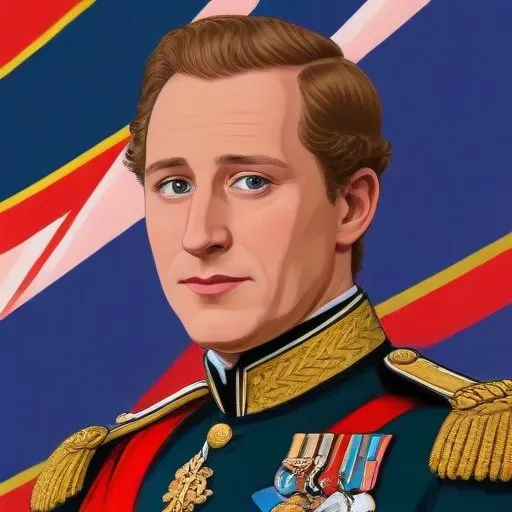
Eldest son of King James I, heir to the English throne, and a patron of the arts, known for his cultural and intellectual pursuits. He was a symbol of hope for a new era of English Renaissance.
Henry Frederick, Prince of Wales, was the eldest son and heir apparent of King James VI and I of England and Scotland, and his wife Anne of Denmark. He was widely regarded as a bright and promising heir to his father's thrones, showing great potential to excel in his future role.
Henry was born on February 19, 1594, at Stirling Castle, Scotland, and automatically became Duke of Rothesay, Earl of Carrick, Baron of Renfrew, Lord of the Isles, and Prince and Great Steward of Scotland.
However, in the month before the baptism, there were rumors at the Scottish court that James VI was jealous of Anne of Denmark and thought that Ludovic Stewart, Duke of Lennox, might be the father of Prince Henry.
Henry's father placed him in the care of John Erskine, Earl of Mar, and his mother Annabell Murray, at Stirling Castle, out of the care of his mother.
Unfortunately, Henry Frederick, Prince of Wales, died of typhoid fever at the age of 18, predeceasing his father.
His younger brother Charles succeeded him as heir apparent to the English, Irish, and Scottish thrones.
Despite his short life, Henry Frederick, Prince of Wales, left a lasting impact on the royal family and the United Kingdom.
Henry Frederick, Prince of Wales, may have had a short life, but his legacy continues to be felt to this day.
Born in 1630
The last monarch of the House of Stuart, restored to the throne after a republican Commonwealth, known for his lavish spending, mistresses, and the Great Fire of London. He ruled with a mix of absolutism and indulgence, shaping England's Restoration era.
Born in 1599
Leader of the Parliamentarian forces during the English Civil War, who later ruled England, Scotland, and Ireland as a republican dictator, known for his military victories and radical reforms.
Born in 1633
The last Catholic monarch of England, Scotland, and Ireland, who attempted to restore Catholicism and absolute monarchy, sparking the Glorious Revolution. He's infamous for his authoritarian rule and religious intolerance.
Born in 1491
A larger-than-life monarch who ruled England with an iron fist, infamous for his six marriages and the English Reformation.
Born in 1516
The first queen to rule England in her own right, Bloody Mary tried to restore Catholicism, earning her notorious reputation for burning hundreds of Protestants at the stake.
Born in 1533
The Virgin Queen, a powerful and beloved monarch, ruled England during a golden age of culture, literature, and exploration, establishing the Church of England and defeating the Spanish Armada.
Born in 1430
King of Scotland from 1437 to 1460, known for his efforts to centralize power and his conflicts with the powerful noble families. He was also a patron of the arts and education.
Born in 1683
King of Great Britain and Ireland from 1727 to 1760, known for his military victories, particularly the Battle of Dettingen, and his role in the War of the Austrian Succession.
