


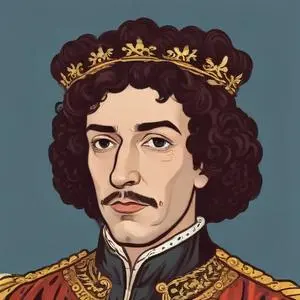
The last Catholic monarch of England, Scotland, and Ireland, who attempted to restore Catholicism and absolute monarchy, sparking the Glorious Revolution. He's infamous for his authoritarian rule and religious intolerance.
James II of England, also known as James VII of Scotland, is infamous for being the last Catholic monarch of England, Scotland, and Ireland, as well as his tumultuous reign that ultimately led to his deposition in the Glorious Revolution of 1688.
Born on October 14, 1633, James was the younger brother of King Charles II and succeeded to the thrones of England, Ireland, and Scotland following his brother's death on February 6, 1685. His accession was met with widespread support in all three countries, largely due to the principles of eligibility based on divine right and birth.
While James's personal Catholicism was tolerated, it did not extend to tolerance of Catholicism in general. The English and Scottish parliaments refused to pass his measures, which led to his attempts to impose them by decree. This move was met with opposition, and some argue that it was a political principle, rather than a religious one, that ultimately led to his removal.
In June 1688, two events turned dissent into a crisis. The birth of James's son and heir, James Francis Edward Stuart, on June 10 raised the prospect of establishing a Catholic dynasty, excluding his Anglican daughter Mary and her Protestant husband William III, Prince of Orange, from the line of succession. The prosecution of the Seven Bishops for seditious libel was viewed as further evidence of an assault on the Church of England, and their acquittal on June 30 destroyed James's political authority in England.
The ensuing anti-Catholic riots in England and Scotland led to a general feeling that only James's removal from the throne could prevent another civil war. In December 1688, James's daughter Mary and her husband William III invaded England, and James fled to France. The English Parliament declared the throne vacant, and William and Mary were crowned as joint monarchs.
James's deposition ended a century of political and civil strife in England by confirming the primacy of the English Parliament over the Crown. His reign is now remembered primarily for conflicts over religious tolerance, but it also involved struggles over the principles of absolutism and the divine right of kings.
James married Anne Hyde in 1660, with whom he had eight children. He later married Mary of Modena in 1673, with whom he had six children.
Despite his tumultuous reign, James II of England remains an important figure in British history, marking the end of Catholic monarchs and the beginning of a new era of parliamentary supremacy.
Born in 1633
The last Catholic monarch of England, Scotland, and Ireland, who attempted to restore Catholicism and absolute monarchy, sparking the Glorious Revolution. He's infamous for his authoritarian rule and religious intolerance.
Born in 1630
The last monarch of the House of Stuart, restored to the throne after a republican Commonwealth, known for his lavish spending, mistresses, and the Great Fire of London. He ruled with a mix of absolutism and indulgence, shaping England's Restoration era.
Born in 1599
Leader of the Parliamentarian forces during the English Civil War, who later ruled England, Scotland, and Ireland as a republican dictator, known for his military victories and radical reforms.
Born in 1683
King of Great Britain and Ireland from 1727 to 1760, known for his military victories, particularly the Battle of Dettingen, and his role in the War of the Austrian Succession.
Born in 1516
The first queen to rule England in her own right, Bloody Mary tried to restore Catholicism, earning her notorious reputation for burning hundreds of Protestants at the stake.
Born in 1650
The Prince of Orange, King of England, Scotland, and Ireland, led the Glorious Revolution, overthrowing the Catholic King James II, and ruled with his wife Mary II, establishing a Protestant monarchy. He's also known for his military victories in Ireland and Europe.
Born in 1676
The first Prime Minister of the United Kingdom, serving from 1721 to 1742, known for establishing the office of Prime Minister and setting important precedents for the role. He is also recognized for his skill in managing Parliament and his role in shaping British politics.
