


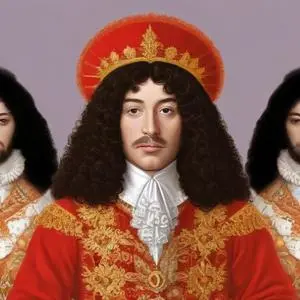
Known as the Sun King, Louis XIV is revered as one of the most powerful and influential monarchs in French history, ruling for an unprecedented 72 years and establishing France as a dominant European power. He is renowned for his extraordinary cultural and artistic achievements, which continue to inspire awe and admiration to this day.
Born on September 5, 1638, to King Louis XIII and Anne of Austria, Louis XIV was destined for greatness from the outset. Following his father's death in 1643, the four-year-old Louis XIV ascended to the throne, with his mother serving as regent until he came of age.
Upon taking control of the government in 1661, Louis XIV embarked on a mission to centralize power, eliminating the feudal system and creating a powerful,absolute monarchy. He abolished the office of prime minister, appointing himself the supreme authority in all matters of state.
Louis XIV was a passionate patron of the arts, commissioning some of the most iconic works of the period, including the Palace of Versailles, the Royal Opera, and the Comédie-Française. He was particularly fond of dance, and his court became renowned for its extravagant ballets, which he often performed in himself.
The palace, built between 1661 and 1710, was Louis XIV's magnum opus, a symbol of French power and culture. With its stunning architecture, exquisite gardens, and opulent decorations, Versailles became the epitome of royal grandeur, attracting visitors from across Europe.
Louis XIV's military campaigns expanded France's borders, securing key territories such as Alsace and Lorraine. He also secured a series of diplomatic triumphs, including the Treaty of Nijmegen in 1678, which recognized France as a dominant European power.
Louis XIV's personal life was marked by a string of romantic conquests, including his marriage to Marie-Thérèse of Austria and his infamous relationships with Madame de Montespan and Madame de Maintenon. He also had several illegitimate children, one of whom, the Duke of Orléans, went on to play a significant role in French politics.
Louis XIV's legacy extends far beyond his reign, influencing art, architecture, and culture for centuries to come. The Palace of Versailles, in particular, has become an iconic symbol of French culture, attracting millions of visitors each year.
Louis XIV's most famous quote, L'état, c'est moi ("I am the state"), reflects his absolute commitment to the monarchy and his unwavering belief in the divine right of kings.
Louis XIV's reign marked the end of feudalism and the beginning of modern nation-building in France. His centralization of power, cultural achievements, and military conquests cemented his status as one of the greatest monarchs in French history.
Unlike his contemporaries, Louis XIV's absolutist rule was marked by a unique blend of cultural achievements and military conquests, earning him a reputation as a visionary leader and astute politician.
In conclusion, Louis XIV's extraordinary life and reign continue to captivate and inspire, offering a fascinating glimpse into the world of 17th-century European politics and culture.
Born in 1755
The last queen of France before the French Revolution, known for her extravagance and mismanagement of the French economy, which contributed to the downfall of the monarchy.
Born in 1632
A 17th-century mastermind who revolutionized French opera, creating lavish productions that captivated the royal court and beyond. He's credited with establishing the French opera tradition.
Born in 1622
A 17th-century master of comedy, he penned witty plays that satirized the French aristocracy, leaving a lasting impact on Western theater. His works remain widely performed and adapted today.
