


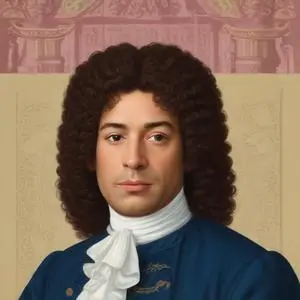
A 17th-century mastermind who revolutionized French opera, creating lavish productions that captivated the royal court and beyond. He's credited with establishing the French opera tradition.
Renowned for his operas and comedie-ballets, Jean-Baptiste Lully is celebrated as a master of the French Baroque music style. As a composer, dancer, and instrumentalist, Lully spent most of his life working in the court of Louis XIV of France, becoming a French subject in 1661 and leaving an indelible mark on the country's cultural heritage.
Born on November 28, 1632, in Florence, Grand Duchy of Tuscany, Lully was the son of Lorenzo Lulli and Caterina Del Sera, a Tuscan family of millers. Although his early education and musical training remain uncertain, his adult handwriting suggests that he was adept at manipulating a quill pen, and he often claimed that a Franciscan friar gave him his first music lessons and taught him to play the guitar.
Lully's talent and charisma soon caught the attention of Roger de Lorraine, chevalier de Guise, who took the young boy to Paris in 1646. He entered the service of Mademoiselle de Montpensier la Grande Mademoiselle, where he honed his musical skills by working with her household musicians and prominent composers of the time.
Lully's collaborations with the playwright Molière resulted in some of his most iconic works, including L'Amour médecin, George Dandin ou le Mari confondu, Monsieur de Pourceaugnac, and Psych. However, his most celebrated work is arguably Le Bourgeois gentilhomme, a comedic masterpiece that showcased his mastery of the comedie-ballet genre.
In addition to his operas and comedie-ballets, Lully composed numerous sacred works, including motets, masses, and Te Deum settings. His music is characterized by its grandeur, elegance, and dramatic flair, reflecting the lavish style of the Sun King's court.
Lully's impact on French music and culture cannot be overstated. He helped establish the Académie Royale de Musique, which later became the Paris Opera, and played a crucial role in shaping the country's musical heritage. His operas and comedie-ballets continue to be performed and admired to this day, influencing generations of composers and musicians.
Furthermore, Lully's collaborations with Molière helped establish the French theatre tradition, paving the way for future playwrights and composers. His work also inspired a new era of French cultural expression, as seen in the development of the Baroque style in art, architecture, and literature.
Lully's personal life was marked by both triumph and tragedy. He was known for his fiery temperament and was involved in several public disputes with his contemporaries. In 1685, he famously struck a staff on the floor during a performance of his opera Te Deum, injuring his foot and eventually leading to his death from gangrene in 1687.
Despite his controversies, Lully remains one of the most celebrated figures in French cultural history. His legacy continues to inspire and influence artists, musicians, and composers to this day.
Lully's contributions to French music and culture are immeasurable. He played a pivotal role in establishing the country's musical heritage, shaping the development of the Baroque style, and inspiring generations of artists and musicians.
In his own time, Lully was hailed as a genius, and his music was admired and performed by the likes of Louis XIV and Madame de Maintenon. Today, his operas and comedie-ballets remain an integral part of French cultural heritage, continuing to delight audiences and inspire new generations of artists.
1632: Born on November 28th in Florence, Grand Duchy of Tuscany
1646: Taken to Paris by Roger de Lorraine, chevalier de Guise
1647-1652: Served as chamber boy to Mademoiselle de Montpensier la Grande Mademoiselle
1652: Exiled to the provinces with Mademoiselle after the Fronde rebellion
1661: Became a French subject and Superintendent of the Royal Music and Master of the King's Music
1662: Granted a pension by Louis XIV
1685: Struck a staff on the floor during a performance of Te Deum, injuring his foot
1687: Died on March 22nd due to complications from gangrene
Born in 1622
A 17th-century master of comedy, he penned witty plays that satirized the French aristocracy, leaving a lasting impact on Western theater. His works remain widely performed and adapted today.
Born in 1683
A prominent figure in the Baroque period, this composer and theorist revolutionized Western classical music with innovative harmonies and treatises on music theory, shaping the course of classical music.
Born in 1668
A renowned Baroque composer and organist, known for his intricate and expressive harpsichord music that showcased his mastery of counterpoint and ornamentation. His works continue to inspire and influence classical music today.
Born in 1714
A pioneering opera composer who revolutionized the art form with his innovative and expressive works, blending music and drama in a way that captivated audiences.
Born in 1660
A French Baroque composer and conductor, known for his sacred music and operas that blended Italian and French styles. He was a prominent figure in French music during the early 18th century.
Born in 1711
A virtuosic violinist and composer, he was a prominent figure in the French Baroque period, known for his innovative and expressive musical style. His works showcased a unique blend of Italian and French influences.
Born in 1606
A 17th-century French mastermind behind iconic plays like "Le Cid" and "Horace", known for pioneering the classical French tragedy genre.
