


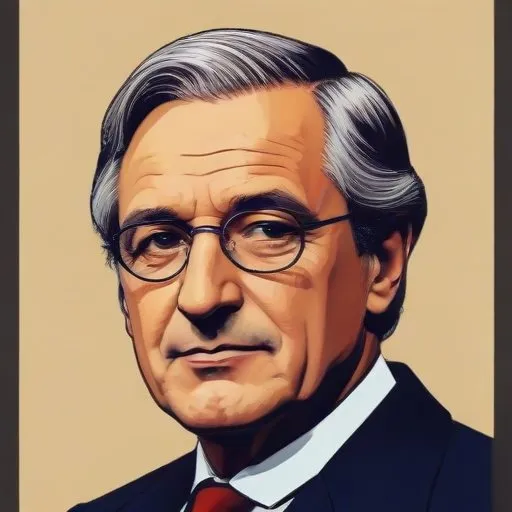
A French lawyer and politician who served as Prime Minister of France, known for his role in the country's Third Republic and his efforts to reform the French government. He's also remembered for his strong stance against the authoritarian General Georges Boulanger.
Charles Floquet, a French lawyer and statesman, is renowned for his unwavering commitment to republicanism and his fearless attacks on the government in a series of political trials during the 19th century. His influential role in the French Third Republic and his unrelenting criticism of authority earned him a reputation as a champion of democracy and human rights.
Born on October 2, 1828, in Saint-Jean-Pied-de-Port, Basses-Pyrénées, Charles Floquet was the son of Pierre Charlemagne Floquet and Marie Locadie Etcheverry. He studied law in Paris and was called to the bar in 1851, where he demonstrated his republican sympathies by participating in the fighting of 1848.
Floquet's brilliant and fearless attacks on the government in a series of political trials earned him a reputation as a formidable orator and advocate for democracy. His scathing indictment of the Empire at the trial of Pierre Bonaparte for killing Victor Noir in 1870 solidified his position as a leader in the republican movement.
In 1867, Floquet was involved in a controversial episode at the Palais de Justice in Paris, where he allegedly said "Vive la Pologne" to Russian Emperor Alexander II, a remark perceived as an impolite affront to the monarch. Floquet later clarified that he had only said "Vive la Pologne," and that a fellow lawyer, Maurice Joly, had added the phrase "Oui, Vive la Pologne, monsieur."
In 1871, Floquet was elected to the National Assembly by the dpartement of the Seine, where he continued to champion the cause of republicanism. During the Commune, he formed the Ligue d'union rpublicaine des droits de Paris, aiming to reconcile with the government of Versailles.
Charles Floquet's unwavering commitment to democracy and his fearless criticism of authority have left an indelible mark on French history. His legacy serves as a testament to the power of courageous leadership and the importance of standing up for one's convictions, even in the face of adversity.
Floquet married Hortense Kestner in 1869, with whom he had a lifelong partnership. He passed away on January 18, 1896, leaving behind a legacy of dedication to the principles of democracy and human rights.
"Vive la Pologne" - a phrase that has become synonymous with Floquet's defiance and commitment to democratic ideals.
Charles Floquet's life and legacy serve as a powerful reminder of the importance of standing up for democratic principles and human rights, even in the face of adversity. His fearless advocacy for republicanism continues to inspire generations to fight for a more just and equitable society.
Born in 1838
A French lawyer and politician who served as Prime Minister of France, known for his key role in the Franco-Prussian War and his efforts to modernize and unify France. He's a significant figure in French history, shaping the country's politics and identity.
Born in 1883
A renowned French actor and director, celebrated for his iconic performances in classic films like "Le Rouge et le Noir" and "Les Enfants du Paradis", showcasing his remarkable range and charisma.
Born in 1807
The 4th President of the French Republic, a lawyer and politician, is known for his strong stance against corruption and his role in establishing the Third French Republic. He's also famous for being the first president to serve a full term.
Born in 1847
A short-lived president who served from 1894 to 1895 and is often overlooked in French history, known for his brief and uneventful term.
Born in 1841
The 7th President of France, known for his scandalous affair with a courtesan that led to his death, and his presidency marked by colonial expansion and labor reforms.
Born in 1838
The 7th President of France, a lawyer and politician, served from 1899 to 1906, known for his role in resolving the Dreyfus Affair and promoting secularism in France.
Born in 1860
A French statesman who served as President of France during a tumultuous period, playing a crucial role in shaping the country's response to World War I. He's also known for his efforts to reform the French economy and stabilize the franc.
