


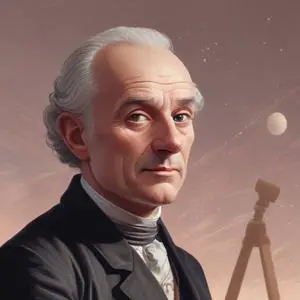
Cataloged many celestial objects, including nebulae and star clusters, creating a famous list still used by astronomers today.
Charles Messier, a renowned French astronomer, is famously known for his meticulous cataloging of 110 nebulae and star clusters, now affectionately referred to as the Messier objects. This celestial compendium has been a guiding light for astronomers and stargazers alike, providing a comprehensive directory of our galaxy's most breathtaking wonders.
Born on June 26, 1730, in Badonviller, Lorraine, France, Messier was the tenth of twelve children. His fascination with the night sky was kindled by the appearance of a great six-tailed comet in 1744, followed by an annular solar eclipse visible from his hometown in 1748. These early experiences sparked a lifelong passion for astronomy, which would soon become his life's work.
Messier's remarkable talent for locating and documenting comets earned him the nickname "Ferret of Comets" by King Louis XV. During his illustrious career, he discovered an impressive 13 comets, including the celebrated Messier-C1760 B1 and Messier-C1763 S1. He also co-discovered several other comets, solidifying his reputation as a master comet hunter.
Messier's most enduring achievement is undoubtedly his celestial catalogue, which has been an indispensable resource for astronomers and stargazers for over two centuries. This comprehensive directory of nebulae and star clusters has facilitated countless discoveries, inspiring generations of astronomers to continue exploring the wonders of our galaxy.
Messier's contributions to astronomy were recognized and celebrated during his lifetime. He was awarded numerous honors, including the Grand Prize of the French Academy of Sciences in 1771 and 1781. Despite his many accolades, Messier remained humble and dedicated to his work, continuing to observe and document the celestial wonders that captivated him throughout his life.
As we gaze up at the starry night sky, we owe a debt of gratitude to Charles Messier, whose tireless efforts have enabled us to better understand and appreciate the beauty of our galaxy. His legacy continues to inspire new generations of astronomers, who build upon his work to unravel the secrets of the universe.
Charles Messier's remarkable life and achievements serve as a testament to the power of dedication, passion, and curiosity. As we continue to explore the vast expanse of our galaxy, we are reminded of the importance of preserving the legacy of those who have come before us, inspiring us to reach for the stars and beyond.
Born in 1473
A Renaissance-era mathematician and astronomer who proposed the heliocentric model, where the Sun is at the center of our solar system, revolutionizing our understanding of the universe.
Born in 1564
Pioneering astronomer, physicist, and mathematician who played a major role in the Scientific Revolution, making key discoveries that challenged Aristotelian views and laid the foundation for modern science.
Born in 1571
A 17th-century trailblazer who discovered the three laws of planetary motion, revolutionizing our understanding of the solar system. He's also credited with being a pioneer in the field of astrology.
Born in 1656
Predicted celestial events, including the return of a comet that bears his name, and made significant contributions to navigation, astronomy, and mathematics.
Born in 1749
Developed nebular hypothesis of the origin of the solar system and formulated Laplace's equation, a fundamental concept in mathematics and physics. He's considered the founder of celestial mechanics.
Born in 1811
Predicted the existence and location of Neptune, a previously unknown planet, through mathematical calculations, revolutionizing astronomy.
91 Years Old
A renowned space expert who explored the universe, searching for life beyond Earth and explaining complex science in simple terms.
