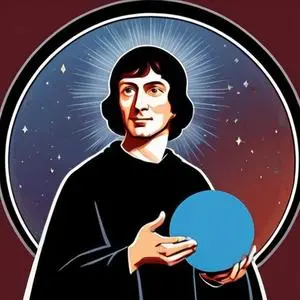
Nicolaus Copernicus

Nicolaus Copernicus

Nicolaus Copernicus was born on February 19th, 1473

Full Name: Nicolaus Copernicus
Nationality: Prussian
Profession: Mathematician
Occupation: Astronomer
Fields: Astronomy, Mathematics
Notable Work: De revolutionibus orbium coelestium
Century: 16th
Known For: Heliocentric Model

A Renaissance-era mathematician and astronomer who proposed the heliocentric model, where the Sun is at the center of our solar system, revolutionizing our understanding of the universe.

Timeline
1473
Born in Toruń
Nicolaus Copernicus was born on February 19, 1473, in Toruń, Kingdom of Poland.
1491
Studied at University of Krakow
Copernicus studied liberal arts, mathematics, and astronomy at the University of Krakow.
1503
Studied at University of Bologna
Copernicus studied law and medicine at the University of Bologna, where he developed an interest in astronomy.
1543
Published De revolutionibus orbium coelestium
Copernicus published his groundbreaking book De revolutionibus orbium coelestium, presenting his heliocentric model of the universe.
1543
Died in Frombork
Copernicus died on May 24, 1543, in Frombork, Kingdom of Poland, leaving behind a legacy that would change the course of astronomy.
Nicolaus Copernicus

Nicolaus Copernicus Quiz

What was the primary contribution of Nicolaus Copernicus to the field of astronomy?

Score: 0/5
FAQ
What is Nicolaus Copernicuss most notable contribution to science?
Nicolaus Copernicus is best known for his heliocentric model of the universe, which placed the Sun at the center of the solar system.
What was Nicolaus Copernicuss education and background?
Nicolaus Copernicus was a Polish mathematician and astronomer who studied at the University of Krakow and the University of Bologna.
What are Nicolaus Copernicuss notable works?
Nicolaus Copernicus wrote several notable works, including De revolutionibus orbium coelestium and Commentariolus.
What was Nicolaus Copernicuss impact on the scientific revolution?
Nicolaus Copernicuss heliocentric model paved the way for later scientists such as Galileo and Kepler, and played a key role in the scientific revolution of the 16th and 17th centuries.
What is Nicolaus Copernicuss legacy?
Nicolaus Copernicus is remembered as one of the most important astronomers in history, and his heliocentric model remains a fundamental concept in modern astronomy.

Related People:

Galileo Galilei

Born in 1564

Pioneering astronomer, physicist, and mathematician who played a major role in the Scientific Revolution, making key discoveries that challenged Aristotelian views and laid the foundation for modern science.

Johannes Kepler

Born in 1571

A 17th-century trailblazer who discovered the three laws of planetary motion, revolutionizing our understanding of the solar system. He's also credited with being a pioneer in the field of astrology.

Tycho Brahe

Born in 1546

A 16th-century astronomer who made precise measurements of the stars and planets, laying the foundation for modern astronomy. His data helped Kepler discover planetary orbits.

Erasmus Reinhold

Born in 1511

Developed the Prutenic Tables, a set of astronomical tables that improved planetary calculations, and was a prominent figure in the development of astronomy during the Renaissance.

Regiomontanus

Born in 1436

A 15th-century mathematician and astronomer who calculated tables of planetary positions and made significant contributions to trigonometry, paving the way for later astronomers like Copernicus.

Martin Luther

Born in 1483

A German monk and priest who sparked the Protestant Reformation, challenging Catholic Church authority and shaping Western Christianity. He's famous for nailing 95 theses to a church door, sparking a religious revolution.