


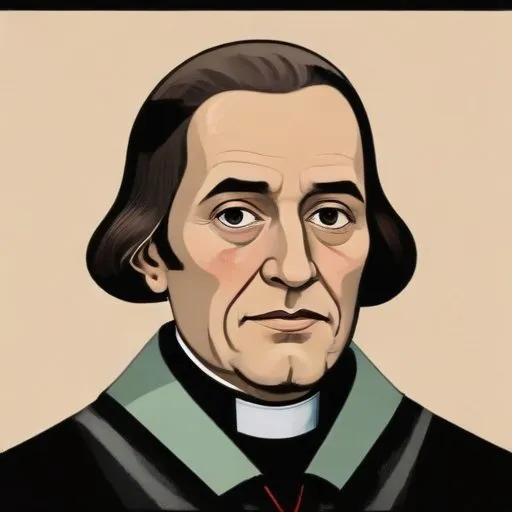
A 15th-century mathematician and astronomer who calculated tables of planetary positions and made significant contributions to trigonometry, paving the way for later astronomers like Copernicus.
Regiomontanus, born Johannes Müller von Königsberg, was a 15th-century mathematician, astrologer, and astronomer who left an indelible mark on the development of Copernican heliocentrism. His groundbreaking contributions to the field of astronomy, particularly in the calculation of planetary orbits and astronomical tables, cemented his status as a luminary of the German Renaissance.
Regiomontanus was born on June 6, 1436, in Königsberg, Lower Franconia. Little is known about his early life, but it is believed that he became a student at the University of Leipzig at the tender age of eleven. He continued his studies at the University of Vienna, where he became a pupil and close friend of the renowned mathematician and astronomer Georg von Peuerbach.
In 1452, Regiomontanus earned his bachelor's degree, and by 1457, he had obtained his master's degree at the age of 21. During his time at the University of Vienna, he lectured on optics and ancient literature, demonstrating his exceptional academic prowess.
In 1460, the papal legate Basilios Bessarion arrived in Vienna on a diplomatic mission. Bessarion, a humanist scholar with a keen interest in mathematical sciences, sought out Peuerbach's company. The two discussed the inaccurate translation of Ptolemy's Almagest by George of Trebizond, which Bessarion deemed unsatisfactory. Peuerbach, aware of his own limitations in Greek, began working on a modernized and improved abridgment of the Almagest instead of a direct translation.
Bessarion invited Peuerbach to join his household and accompany him to Italy, contingent upon Regiomontanus being allowed to join as well. Peuerbach accepted the invitation, and the trio set out to create a new, accurate translation of the Almagest.
Regiomontanus' most notable contributions to astronomy came in the form of his Ephemeri, a comprehensive collection of astronomical tables that calculations of planetary positions for the years 1475 to 1506. This groundbreaking work allowed astronomers to make precise predictions of celestial events, revolutionizing the field of astronomy.
His Ephemeri also included tables of eclipses, planetary conjunctions, and lunar cycles, making it an indispensable resource for astronomers of the time. Regiomontanus' work on astronomical tables laid the foundation for later astronomers like Copernicus and Tycho Brahe to build upon.
Regiomontanus' contributions to astronomy had far-reaching consequences, influencing the development of Copernican heliocentrism in the decades following his death. His work on astronomical tables and planetary orbits remained unmatched for centuries, earning him recognition as one of the most important astronomers of the 15th century.
Phillip Melanchthon, a prominent Protestant theologian and reformer, first used the toponym Regiomontanus in 1534, solidifying Regiomontanus' place in the annals of history. Today, Regiomontanus is remembered as a pioneering figure of the German Renaissance, whose work paved the way for future generations of astronomers.
Regiomontanus' contributions to astronomy had a lasting impact on the development of modern science. His work on astronomical tables and planetary orbits laid the groundwork for later astronomers to build upon, paving the way for significant advancements in fields like astrophysics and space exploration.
Today, Regiomontanus' legacy serves as a reminder of the importance of precision, accuracy, and innovation in scientific pursuits, inspiring future generations of scholars and researchers to strive for excellence.
Born in 1459
A German navigator and geographer who created one of the earliest surviving world globes, accurately depicting the Old World and predicting the New World. He also led expeditions to West Africa and the Atlantic Islands.
Born in 1380
Unified the Crown of Aragon, ruling over a vast territory in eastern Spain, and sponsored the voyages of Christopher Columbus, leading to the discovery of the New World.
Born in 1451
Unified the Spanish kingdoms, sponsored Christopher Columbus's voyage to the Americas, and established the Spanish Inquisition.
Born in 1473
A Renaissance-era mathematician and astronomer who proposed the heliocentric model, where the Sun is at the center of our solar system, revolutionizing our understanding of the universe.
Born in 1546
A 16th-century astronomer who made precise measurements of the stars and planets, laying the foundation for modern astronomy. His data helped Kepler discover planetary orbits.
Born in 1571
A 17th-century trailblazer who discovered the three laws of planetary motion, revolutionizing our understanding of the solar system. He's also credited with being a pioneer in the field of astrology.
