


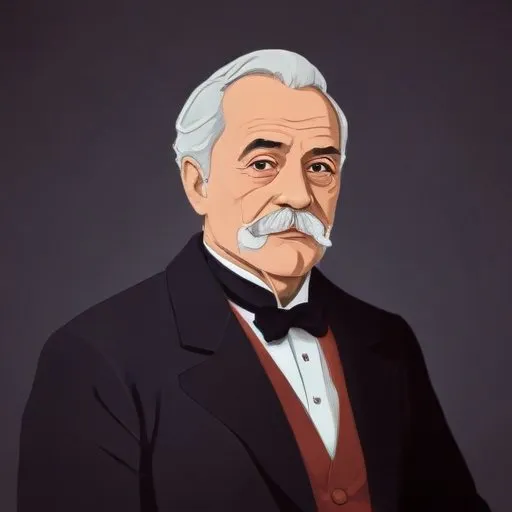
A 15th-century mathematician and astronomer who calculated tables of celestial bodies and made significant contributions to the development of trigonometry. His work laid the foundation for later astronomers like Copernicus and Regiomontanus.
Georg von Peuerbach, a 15th-century Austrian astronomer, poet, mathematician, and instrument maker, is renowned for streamlining Ptolemaic astronomy in his seminal work, Theoricae Novae Planetarum. This groundbreaking text made astronomy, mathematics, and literature accessible to Europeans during the Renaissance and beyond.
Little is known about Peuerbach's life until he enrolled at the University of Vienna in 1446. Born in the Austrian town of Peuerbach in upper Austria, his exact date of birth is determined by a horoscope published 89 years after his death, placing it on May 30, 1423.
A priest from his hometown, Dr. Heinrich Barucher, recognized Peuerbach's academic abilities from a young age and introduced him to Georg Muestinger, the Augustinian provost of Klosterneuburg Monastery. Muestinger's course, Theoricae Planetarum, at the University of Vienna inspired Peuerbach to enroll.
At the University of Vienna, Peuerbach received his Bachelor of Arts in 1448 and a Master of Philosophy in 1450. He studied mathematics under the guidance of Johann von Gmnden, with a curriculum composed primarily of humanities courses. Notably, he developed his knowledge of astronomy through independent study, possibly under the influence of followers of John von Gmnden.
In 1451, Peuerbach observed the occultation of Jupiter by the Moon, marking the beginning of his astronomical pursuits. His work, Theoricae Novae Planetarum, presented a simplified and accessible explanation of Ptolemaic astronomy, making it a fundamental textbook for European astronomers during the Renaissance.
Peuerbach's legacy extends beyond his own work, as he played a significant role in establishing astronomy as a discipline at the University of Vienna. Throughout the 15th and 16th centuries, his teachings inspired generations of astronomers, shaping the course of astronomical studies in Europe.
Georg von Peuerbach's life, though not extensively documented, is marked by significant events that shaped his academic pursuits and contributions to astronomy.
Georg von Peuerbach's remarkable contributions to astronomy, mathematics, and literature have left an indelible mark on the Renaissance and beyond. His dedication to simplifying complex concepts has inspired generations of scholars, cementing his place as a pioneering figure in the history of astronomy.
Born in 1436
A 15th-century mathematician and astronomer who calculated tables of planetary positions and made significant contributions to trigonometry, paving the way for later astronomers like Copernicus.
Born in 1473
A Renaissance-era mathematician and astronomer who proposed the heliocentric model, where the Sun is at the center of our solar system, revolutionizing our understanding of the universe.
Born in 1546
A 16th-century astronomer who made precise measurements of the stars and planets, laying the foundation for modern astronomy. His data helped Kepler discover planetary orbits.
Born in 1571
A 17th-century trailblazer who discovered the three laws of planetary motion, revolutionizing our understanding of the solar system. He's also credited with being a pioneer in the field of astrology.
Born in 1551
German astronomer who discovered the binary star Mizar and made significant contributions to the field of astronomy, particularly in the study of double stars.
Born in 1471
A Renaissance master of intricate woodcuts and engravings, known for precise and detailed depictions of nature and human form, influencing art and mathematics for centuries.
Born in 1452
A 15th-century German mathematician and astronomer who calculated planetary positions and developed trigonometric tables, contributing significantly to the field of astronomy. His work influenced later astronomers like Copernicus and Regiomontanus.
